|
Review by
Calvin
McMillin: |
If The Twilight Samurai
was meant in part to deconstruct the samurai film as
a genre, then The Hidden Blade takes that attitude
to the next level by introducing two elements not fully
explored in the previous film - the idea that faithful
samurai were forced to due the bidding of corrupt officials
and the effect that Western firearms had on the samurai
way of life. Whereas Twilight Samurai innovatively
focused its attention on the home life of a lowly, but
noble samurai with a family to support, The Hidden
Blade centers on a more traditional figure in the
chambara film - the lone swordsman of samurai legend.
However, this lone wolf isn't a ronin, but a faithful
vassal, one who has never killed before and is about
to come to a crossroads in his life, as he begins to
wonder if the samurai way really is all that it's cracked
up to be.
The film begins with two
pals, Munezo Katagiri (Masatoshi Nagase) and Samon Shibada
(Hidetaka Yoshioka), bidding farewell to Yaichiro Hazama
(Yukiyoshi Osawa) as he heads to take an important post
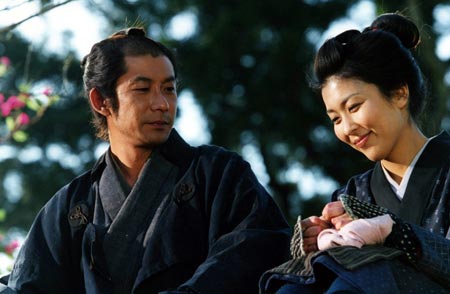
in Edo. Afterwards, they head to Munezo's home, which
is occupied by his mother, his sister Shino (Tomoko
Tabata), and the maid Kie (Takako Matsu). It seems that
Kie grew up on a farm and is living with the Katagiri
family until she learns enough about taking care of
a household so she can find a good husband. Together,
they eat, drink, and have a good time with one another.
All in all, it seems like an idyllic sort of life.
Flash forward three years,
and Samon has married Shino, Munezo's mother has passed
away, and Kie has been married into a prestigious family.
One day, the still single Munezo happens upon Kie while
she is shopping and is shocked by her change in appearance.
This chance meeting sets off a chain of events in which
Munezo eventually finds out that Kie has been treated
so poorly that she's on the brink of death, a fact which
immediately compels him to rush to Kie's aid, command
that divorce proceedings take effect against her no-good
husband, and bring her back to his own house for safekeeping.
Over time, Kie is nursed
back to health, and she returns to the role she occupied
three years earlier, taking care of the house and Munezo
in particular. However, this newfound happiness is threatened
when Yaichiro is implicated in an internal clan conspiracy.
This spells trouble for Munezo because both he and Yaichiro
were students of Kansai Toda (Min Tanaka), master swordsman-turned-humble
farmer.
Although Yaichiro was the superior swordsman,
Toda passed on the secret of "The Devil's Claw"
to Munezo instead, a fact that has always eaten at Yaichiro.
During the investigation, Munezo is asked by his superior
to name names in connection with Yaichiro. Although
Munezo has no knowledge of Yaichiro's dealings, he not
only passes on answering the question, but goes one
step farther by telling that he feels it is dishonorable
for a samurai to inform on others, an act which only
infuriates his superiors, soon putting him a very awkward
position politically.
Although the relationship
between Kie and Munezo is blossoming, both have become
the subject of vicious rumors that Munezo has taken
her as his mistress. Since Munezo is aware that a samurai
cannot marry someone of low caste, and is fearful that
the gossip will negatively affect her prospects to remarry,
he reluctantly sends her away to her parents' home,
much to Kie's eternal disappointment.
Things only get
worse when Yaichiro escapes from jail and takes several
unsuspecting innocents hostage. Hiding in their farmhouse,
Yaichiro swears to kill each and every person who enters
the hovel. Given a direct order by his superiors to
kill Yaichiro, Munezo has no choice but to face his
former classmate in a duel to the death. Will Munezo
survive? And if he does, is there still hope for him
and Kie? And what's to be done about Munezo's duplicitous
superior?
Especially when viewed
back-to-back, The Hidden Blade and The Twilight
Samurai bear remarkable similarities to one another
in terms of plot and character. In truth, the Kie/Munezo
relationship is simply a repeat of the Tomoe/Seibei
relationship from the first film with issues of money
and class standing still being of major importance.
Munezo is given an order he can't refuse much as Seibei
was, and they both must face their adversary in a confined
space. And of course, the thought of impending death
has both characters re-evaluating both their values
and their lives in a wholly dramatic fashion. For viewers
who don't mind getting a second helping of Twilight
Samurai in a different form, then these repeats
shouldn't be too distracting, perhaps even welcome.
But that isn't to say
the film is merely a retread. Where Hidden Blade primarily differs is in its extended exploration on
how the age of the samurai is soon coming to an end,
an issue suggested in Twilight Samurai, but made
explicit here with the intrusion of Western weaponry
into the narrative. This feature of the plot comes to
the surface in the final duel between Munezo and Yaichiro,
a battle that harkens back to one of the climactic showdowns
in the first Once Upon a Time in China film -
in both movies Western technology ultimately inserts
itself into what is meant to be a private duel of honor.
Whatever the film's merits,
there's no doubt that some viewers may be put off by Hidden Blade's more than passing resemblance
to Twilight Samurai. Even so, the movie's compelling
romantic angle and occasional comic moments help matters
considerably, as the film begins to take a shape of
its own. Considering how great the first film was, it's
still a shame that the new ideas included in Hidden
Blade simply couldn't have been developed earlier
in Twilight Samurai, particularly the climactic
student against student duel (which trumps - at least
in concept - Seibei's duel with a swordsman he doesn't
know), the intrusion of western firearms (which helps
punctuate the narrative's overarching theme), and the
idea of a special hidden technique (when finally unleashed,
"The Devil's Claw" proves to a surprisingly
fatal move).
Perhaps its nature of these very additions
that compelled Yamada to make Hidden Blade in
the first place; maybe he just wanted to get them onscreen.
Whatever the case, the film serves as a wonderfully
satisfying companion piece to Yamada's award-winning
2002 film. The film's denouement recalls certain classic
movie moments, not only among samurai films, but from
some of the best cowboy films as well, a welcome bit
of nostalgia within the film's less than flattering
commentary on the feudal era. Although Hidden Blade successfully dips back into the well once more, here's
hoping that the third film in Yamada's proposed trilogy
proves to be more innovative. (Calvin McMillin, 2005) |
|