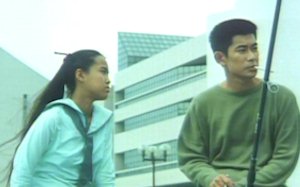
|
Cast: |
Masatoshi
Nagase, Li Pui-Wai, Choi Siu-Wan, Maki Kiuchi, Suen
Chung-Hung, Sung Lap-Yeung, Tsang Yuet-Guen, Chu Kit-Ming,
Ang Ching-Yee, Yue Siu-Ting, Ngai Wai-Man, Lee Yee-Ping |
|
|
Review
by Kozo: |
This languid drama from celebrated international director
Clara Law is anything but uninteresting. Li Pui-Wai
stars as Pui-Wai, a fifteen year-old Chinese girl on
the cusp of adulthood - and soon to lose her past via
immigration to Canada. In her final year in HK, she
befriends Tokio (Masatoshi Nagase), a wandering Japanese
traveler who’s retreated to HK to eat and sleep, fish
and fornicate.
Pui-Wai struggles with experiencing
her first love, all the while consciously aware that
she’s about to lose him to her impending immigration.
Meanwhile, Tokio runs into his first love’s sister (Maki
Kiuchi), and can’t even remember who she is. This parallel
reveals Tokio’s narrative relation to Pui-Wai. He’s
her future made real: once wide-eyed and keenly aware
of his memories, he’s now jaded and without recall of
the little things that compose his life.
There is a gentle give-and-take
to the relationship between these two disparate, yet
kindred souls. Both share the same appreciation for
life: one has merely forgotten while the other struggles
with the bittersweet aftertaste of her memories. Pui-Wai
rejects Tokio’s hard-hearted shell - it’s only through
his exposure to her that he begins to remember and recognize
the beauty and joy in his past.
While this sounds like a supremely
cheesy setup, Clara Law and Eddie Fong manage to tell
their tale both subtly and simply. Using single camera
set-ups, seemingly unrelated subplots, and generous
long takes, they bring their message across both verbally
and metaphorically. This is a film about silent revelation
and quiet introspection, and not bombastic ephiphany.
Wong Kar-Wai can be seen in
this film, but credit for the similar paths both Autumn
Moon and Wong Kar-Wai travel should be given to
another source: Japanese author Haruki Murakami. In
Murakami novels like Hard Boiled Wonderland and the
End of the World and A Wild Sheep Chase,
the subject is society and how it affects the individual.
His novels are meditations on urban alienation, as people
struggle to reconcile themselves with the times they
live in. The same can be said for the characters in Autumn Moon, who form a rare friendship that
illuminates the value and fragility of memory. Ultimately,
the film reveals life as a cyclical process - everything
repeats itself elsewhere, both an unavoidable and a
precious process. This film isn’t explicit about what
it says, but more is conveyed than whole pages of text
possibly could. (Kozo 1998) |
|