 When
and How
When
and How
On
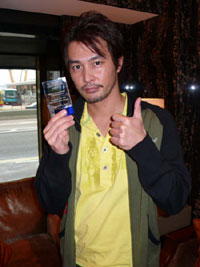
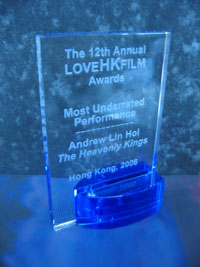
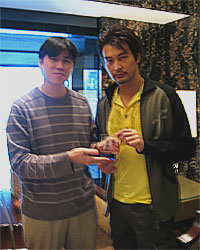
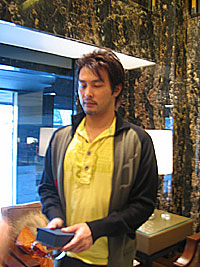
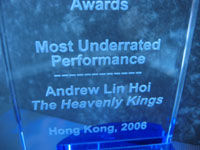
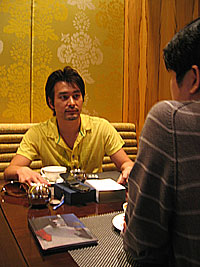
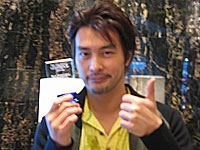
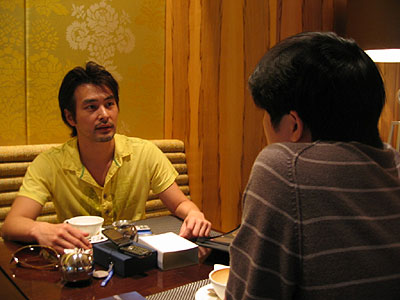
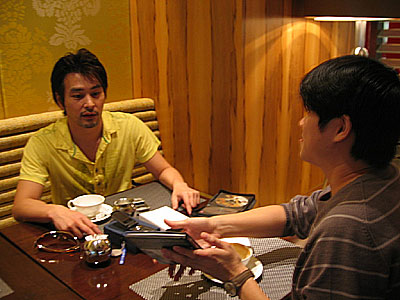
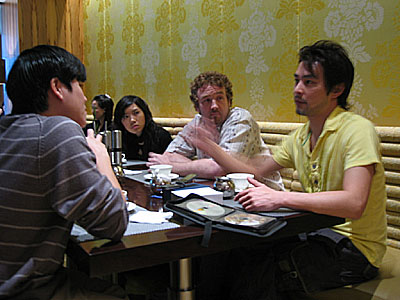
March 18, 2007, LoveHKFilm staff met with actor Andrew
Lin at the Mandarin Oriental Hotel in Central, where
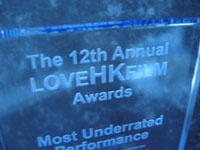
he accepted his recent LoveHKFilm award for "Most
Underrated Performance", for his portrayal of,
uh, himself in the fan-favorite mockumentary The Heavenly
Kings. Previous to this, LoveHKFilm.com had never officially
met with any HK Entertainment personalities. We're
glad that Andrew Lin was the first one because he was
down-to-earth and easy to talk to, plus he actually
agreed to talk to us. The novelty of this meetup does
not escape us.
The circumstances for this happening were circuitous
and rather coincidental, but here's the short version:
somehow Andrew Lin heard of the LoveHKFilm.com Awards
and posted it on alivenotdead.com. Coincidentally, one
of Kozo's friends knows Terence Yin, who of course knows
Andrew Lin. A week or so later, we managed to put this
thing together, which in total required eight phone
calls an an extra week to prepare the first ever physical
LoveHKFilm Award. One day we may attempt to hand out
more.
Special
Thanks to:
Sean Tierney, Winnie Chan, Paul Hong
and of course Andrew Lin.
|
|
|
|
When Andrew Lin showed
up at the Mandarin Oriental Hotel to accept his awarddidn't
start the boy band Alive in order to resurrect his flagging
career, and he didn't invite Conroy Chan to be a member
to make sure there was a member of the band that was
worse than him. The above entertaining details and more
came to light in the entertaining 2006 mockumentary
The Heavenly Kings, which was produced by Lin and his
bandmates Daniel Wu, Terence Yin, and Conroy Chan. Also
directed by Wu, The Heavenly Kings was a breath of fresh
air in the usally stale Hon
are first gained notice in the 1998 Ching Siu-Tung actioner
The Blacksheep Affairs, opposite Zhao Wen-Zhou and Shu
Qi, and made an impresson on audiences with his good
looks and, for some fans our West, his agility with
martial arts scenes. "xxxxxxxx" Blacksheep
Affairs"
Other films"
Typecast as villains,
ending in Naked Weapon: "Quote"
Lin was soon a hot commodity
in Hong Kong Cinema, appearing in a variety of genres
for different filmmakers, including directors Gordon
Chan (2000 A.D.), Clifton Ko (Love Paradox), and Derek
Chiu (Love au Zen), and producer Stanley Kwan (The Accident).
However,
Unfortunately, the late
nineties also saw a crisis for the Hong Kong film industry,
with declining attendance, piracy, and reduced investment
preventing actors and filmmakers from producing the
variety and output of films that drove the industry
to international promienence. As a result, many actors
and filmmakers were marginalized, never getting the
opportunities they might had received if the industry
were more robust.
One could say Andrew
Lin's career fell into that category, and he soon was
often typecast in villain roles.
On the Hong Kong film Industry...
The Heavenly
Kings....
Future projects...
Ninja commercial...
Proclaiming that Kill
Bill: Volume 1 is a movie for people who really
love movies isn't an entirely accurate statement—it's
actually tailor-made for a special kind of crowd. It's
for people who love Spaghetti Westerns, bloody Chang
Cheh flicks, and off-the-wall anime. It's for filmgoers
who have an affinity for blaxploitation pictures and
go around quoting Sam Raimi's Evil Dead series
to their friends. This is a flick for chambara
addicts, Zatoichi aficionados, and folks who
just couldn't get enough of the shockingly bloody finale
of Sanjuro. In short, it's the ultimate film
geek experience.
Volume 1 is certainly
a bold film to say the least. Not many filmmakers would
have the guts or the clout to put a Japanese language-only
anime sequence (of O-Ren Ishii's origin) right smack
dab in the middle of a mainstream, live action film.
In fact, the sheer amount of sequences with English-subtitled,
Japanese language-only dialogue is astounding. This
decision to allow the characters to speak as they naturally
would rather than forcing the Japanese actors to recite
all their lines in broken English is a refreshing change
of pace from the standard "East Meets West"
On some of his earlier
films
—Sanjuro
10/20/03
|