|
|
| |
|
 We do news right, not fast
Note: This blog expresses only the opinions of the blog owner,
and does not represent the opinion of any organization or blog
that is associated with The Golden Rock.
|
|
Archive for the ‘feature’ Category
Monday, January 11th, 2016
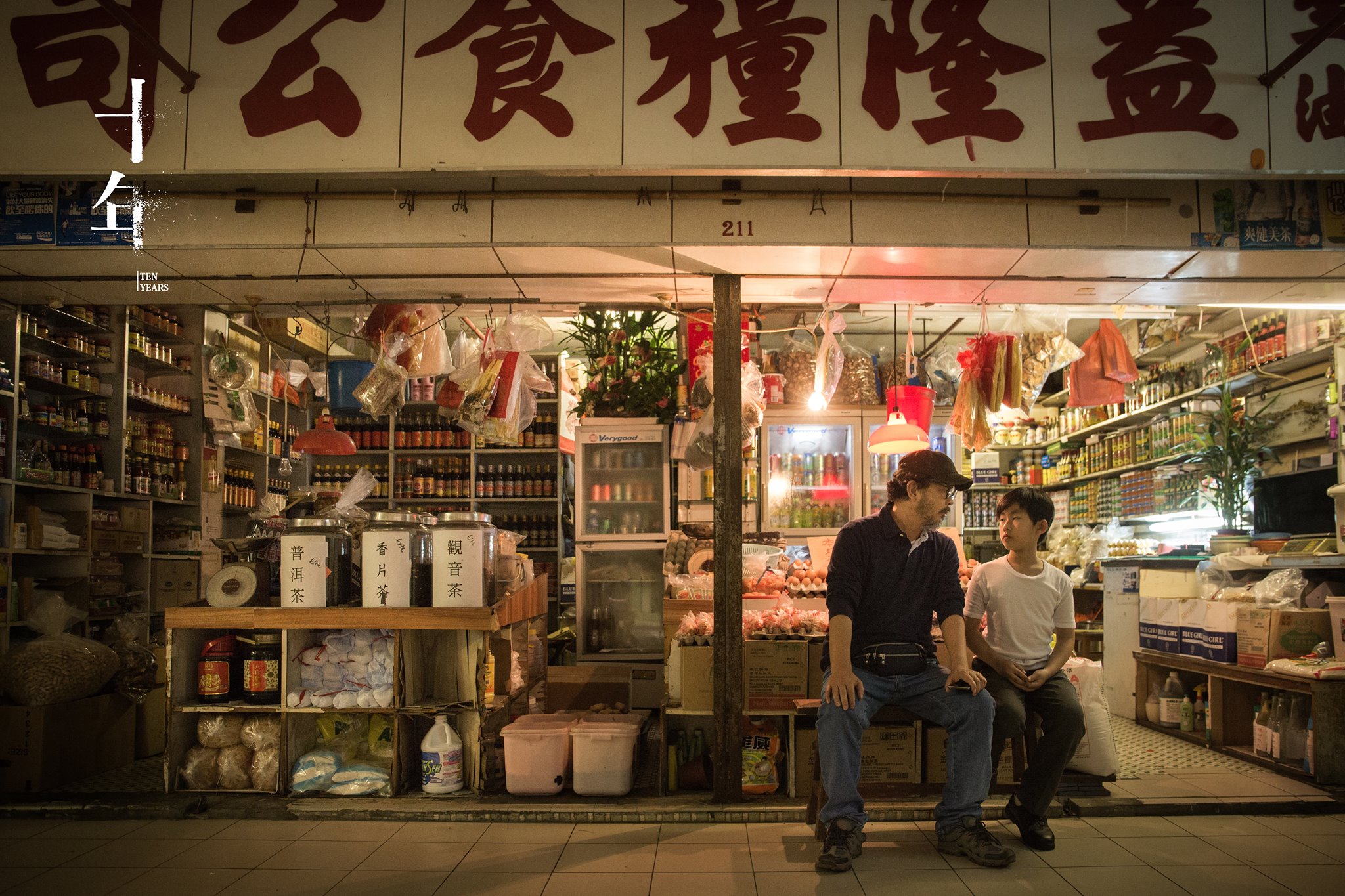
In the past three weeks, one film has been at the tip of young people’s tongues in Hong Kong, and it ain’t Star Wars.
Produced by Ng Ka Leung, Ten Years is an omnibus film featuring five shorts centered around a single question: What will Hong Kong be like ten years from now? In one film, a taxi driver struggles to keep his living after Mandarin becomes the dominant language. Another film peels back a mystery surrounding the identity of a self-immolation protester outside the British consulate. Another about ta grocery store owner whose son has joined the red scarf-wearing youth brigade.
In case you can’t tell by now, the shorts clearly highlight a certain anxiety over Hong Kong’s political situation; anxiety over losing Hong Kong’s unique culture, anxiety over “mainlandization”, anxiety over the death of Hong Kong as we know it. It’s activist cinema filtered through the perspective of the Umbrella Movement generation.
Despite the misfortune of opening in one cinema on the same day as Star Wars, the intensely political film has been playing to sold-out shows for the past three weeks. It has since spread to five screens and made HK$2.2 million - astonishing for a release of such limited scale.
What sets Ten Years apart from the countless speeches and satiric videos we’ve seen from liberal (or Pan-Democrat) activists, politicians and artists? One word: Storytelling.
As effective as a great speech can be, didactic lectures appeal only to those who are already subscribing to what you’re selling. The same goes for satire - sure, it’s funny to people who know what’s being made fun, but it’s not going to win the hearts and minds of those who haven’t been won over.
What Ten Years takes advantage of is mankind’s most important tool. The art of storytelling is how we learn our history, our sense of morals, our beliefs. Our love for storytelling has exploded into art forms that can be bought and sold. Billions of dollars are made from storytelling in various formats, from books to films and even to music, because it is our most effective form of communicating ideas to one another. Remember how Han Solo won over the Ewoks in Return of the Jedi? C3PO’s storytelling skills.
By projecting the anxiety of liberal Hong Kong into these stories, the filmmakers make a strong, emotional case for what Hong Kongers should be worried about in the future - forced assimilation into China, loss of civil liberties, the ongoing re-colonization of Hong Kong. In other words, Ten Years may have what it takes to bring people over from the other side. The film shows a scary situation, and the film may just be what’s needed to wake people up.
Hong Kong cinema began as a commercial industry, and it has always been driven by commercial needs. There may have been a period of artistic innovation in the 80s, but young filmmakers now face an entire generation of gatekeepers with plenty of excuses to maintain status quo.
Hong Kong cinema has been limping for years, struggling - and failing - to find another critical success that would put it back in the global spotlight. Meanwhile, local audience drown in the waves of nostalgia, still clinging to films with stars of the past as the local entertainment industry fails to build up a new generation of talents worthy of take the torch.
That’s why Ten Years come as a breath of fresh air. It’s a socially and political relevant film that’s mostly well-made. It doesn’t cover itself with schmaltzy sentimentality. It holds up a binocular in front of Hong Kong and tells them this may be what they see on the other side. If the filmmakers can get enough people to look, Ten Years may one of the most important film Hong Kong has made in years.
See Kozo’s review of the film here.
Posted in feature, Hong Kong | Comments Off
Tuesday, January 3rd, 2012
Representing everyone here at The Golden Rock (i.e. me), we wish everyone a happy new year and an excellent 2012. 2011 has been an eventful year in the film industries of China and Hong Kong, and it’s about time to look back at everything that’s happened over the last 365 days.
My Hongmen Banquet can kick your Hongmen Banquet’s ass
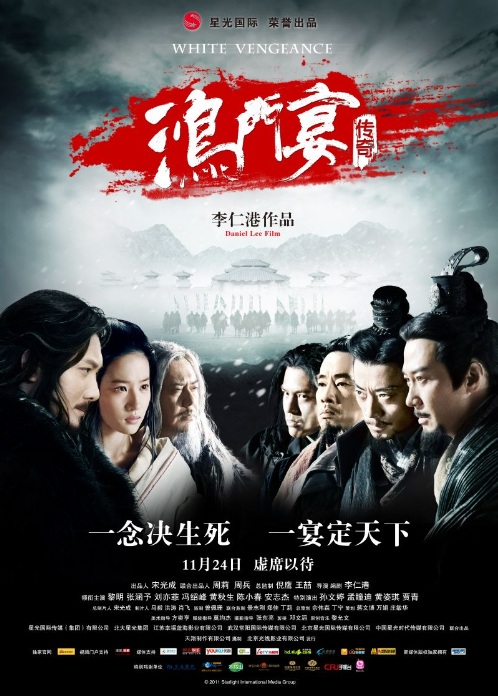
This year started off with a literal clash of idea, as two films about the same topic went into production. After Lu Chuan was removed from his own planned Hongmen project, his original investors then brought on Daniel Lee (DRAGON SQUAD! 14 BLADES!), as well as a cast that includes Leon Lai, Jordan Chan, Zhang Hanyu, and Anthony Wong for what became WHITE VENGEANCE.
However, Lu Chuan went on to find the funding he needed to make his own Hongmen Banquet movie starring Daniel Wu, Liu Ye, and Chang Chen. While WHITE VENGEANCE was released in late November and became Lee’s highest-grossing film at 152 million yuan (more later on whether this is a success or not), Lu’s film reportedly ran over budget and over schedule. We’ll likely see it this year.
Box office surprises - TV owns Lunar New Year box office

Lunar New Year is undoubtedly one of the biggest times for movies here in Asia. While no one’s surprised that Benny Chan’s mega-budget SHAOLIN won the Lunar New Year battle in China with 216 million yuan, not many expected that the other two 100 million yuan-grossers in China would be based on TV series.
In the spirit of Hong Kong’s own nonsensical comedic style, hit sitcom MY OWN SWORDSMAN left its single-stage setting and leapt to the big screen, packing cinemas across China to gross an astounding 196 million yuan. Director Shang Jing is already set to make another Lunar New Year comedy hit in 2012 with DINNER PARTY.
Not far behind the success of SWORDSMAN was another TV-based film. Coming at the end of the Lunar New Year holidays, Zhang Yibai’s ETERNAL MOMENT was mainly aimed at Valentine’s Day audiences in urban areas. The continuation of his 1998 television series CHERISH OUR LOVE FOREVER - dubbed China’s first idol drama - ETERNAL MOMENT gave CHERISH’s fans a chance to look back on their own youth and love with a choose-your-own-adventure-ish reunion of the show’s two lovers. While feedback on the film is mixed, it captured enough lovers to make 207 million yuan.
While these two films grossed a little less than SHAOLIN, remember that these two films each cost only a third of SHAOLIN’s budget.
In Hong Kong, the situation was similar, as local broadcaster TVB’s second Lunar New Year film I LOVE HONG KONG even beat the likes of Donnie Yen, Louis Koo, and Andy Lau to become the local winner of the Lunar New Year box office. The Raymond Wong-TVB competition is back again this year, but with TVB unable to get a solid pop star cast due to its contractual conflict with Hong Kong’s major record companies, Wong may have a chance to finally beat the television monopoly.
I gouges your money, American robots! I gouges it!
It’s expected that the government would be ordering treating its employees to watch Communist Party celebratory film BEGINNING OF THE GREAT REVIVAL, which limped to a 412 million yuan gross this summer (below FOUNDING OF A REPUBLIC’s 420 million yuan total). However, what we didn’t expect is what the film industry’s way to support other propaganda films.
To paraphrase my posts from earlier this year (This one and this one), at least one cinema chain passed around a memo looking for new ways to promote “excellent recommended films” that commemorated the 90th anniversary of the China Communist Party - YAN SHAN ZHOU, SPACE DREAM (or WENTIAN), and GUO MING YI. One of the tactics they used were double feature tickets. Taking advantage of Hollywood blockbusters TRANSFORMERS and HARRY POTTER (Chinese blockbuster WU XIA was also a rumored target), cinemas attached an additional ticket to one of the three “excellent recommended films” for anyone who bought a ticket to these big blockbusters. While ticket price remained the same for these big films, cinemas gave a share of the ticket price to the “excellent recommended films” since whatever price is printed on the ticket goes to the box office gross.
Such tactics led to wild box office patterns for these “excellent recommended films”, as you can see in my earlier post. Since there’s no such law in place yet for how cinemas sell tickets (each ticket for the major blockbusters was still above the mandated minimum ticket prices) and that these films were all “morally positive” works that glorified the Communist Party, there were no repercussions from anyone. Even the western media were so having so much fun from GREAT REVIVAL that they simply ignored this happened. In the end, it was a win-win situation, as TRANSFORMERS still became the highest-grossing film of the year in China with 1.1 billion yuan, and the three propaganda films made a good chunk of money, too.
However, this is all about to change, as the government is set to enforce new laws aimed to stop dishonest accounting by cinemas. The government is also aiming to further reduce the power of cinemas by mandating that they cannot take more than 50% of box office revenue. More on that later.
Box office surprises - The fall of the titans

In recent years, Donnie Yen and Jackie Chan are names that would typically do well in China (just Donnie for Hong Kong - no one cares about Jackie anymore here), but 2011 has been one disappointment after another for these action superstars.
Donnie started 2011 off with ALL’S WELL ENDS WELL 2011, which managed to gross 167 million yuan in China - not bad for a Hong Kong-style Lunar New Year comedy. However, his two big action films this year both came with plenty of hype and ended with middling grosses. LOST BLADESMAN not only featured a well-known Romance of the Three Kingdoms character as its hero, it also co-starred Jiang Wen, who wrapped up 2010 with LET THE BULLETS FLY. However, the Alan Mak/Felix Chong film suffered a major drop in box office after opening with 100 million yuan in the first six days due to poor word-of-mouth. In the end, the film did gross 162 million yuan, disappointing for a film that reportedly cost 150 million yuan to produce. The film suffered a similar fate in Hong Kong, grossing just HK$8 million after a strong opening weekend.
The disappointment continued with Peter Chan’s WU XIA. The Chan-produced BODYGUARDS AND ASSASSINS (which co-starred Donnie) made 296 million yuan back in 2009, and his last directorial effort WARLORDS also made 200 million yuan back in 2007 (a very, very high figure for 2007). Even with Chan directing, Takeshi Kaneshiro co-starring, and no direct competition for two weeks, the action film followed a similar pattern as LOST BLADESMAN, opening with 100 million yuan in its first week and wrapping its run with 176 million yuan. The film did even worse than LOST BLADESMAN in Hong Kong, also grossing just HK$8 million. With this and MR. AND MRS. INCREDIBLE (which he produced) grossing only 51 million yuan in the Lunar New Year period, Peter Chan, who has become his own boss now, must be feeling a little lost right now.
After LITTLE BIG SOLDIER grossed a surprising 160 million yuan in China, all eyes were on Jackie Chan with his historical epic 1911. Costing over 100 million yuan to make (some estimates even put it at US$30 million, roughly 200 million yuan), the film managed to limp to a 61 million yuan gross after hanging on the box office chart for 10 weeks (though no one knows how that happened). LEGENDARY AMAZONS, the period action film produced by Jackie’s production company, also suffered a terrible fate, grossing only 39 million yuan. Both films also did barely any business in Hong Kong.
Creation of a new box office poison - Cecilia Cheung

2011 started well for Cecilia Cheung, who made her first big-screen appearance since 2006 with ALL’S WELL ENDS WELL 2011. However, it went downhill for the actress as the tabloids picked up her airplane photo with former scandal maker Edison Chen, her well-publicized divorce with Nicholas Tse, and her well-documented MIAs on film sets.
Cecilia also continued to make dubious career choices, as she turned down a starring role in the next Derek Yee film for a higher salary from Wong Jing’s TREASURE HUNT. She also took part in the disastrous LEGENDARY AMAZONS, a “special appearance” in Jingle Ma’s critically lambasted SPEED ANGELS, and THE LION ROARS 2, which Louis Koo didn’t even bother doing. She also continues to command a very high salary, including a rumored 16 million yuan for the DANGEROUS LIAISONS remake co-starring Zhang Ziyi. Will Cecilia do better in 2012, and how long will she continue to command this kind of price from investors?
Did I mention that LEGENDARY AMAZONS cost 100 milion yuan to produce? Cecilia took 15 of that.
Box office surprises - It’s all about the young’uns
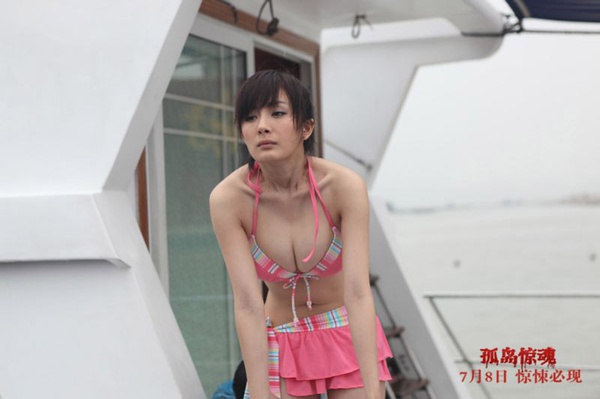
2011 also told us that young people spend a lot of money, and they’re willing to spend a lot of it at the movies. In July, horror film MYSTERIOUS ISLAND grossed an astonishing 91.8 million yuan at the box office, despite opening directly opposite Donnie Yen and his chest in WU XIA. A part of its success (perhaps a large part) can be attributed to the popularity of star Mini Yang, whose fans organized group screenings for the film. While it hasn’t happened yet, MYSTERIOUS ISLAND is suppose to lead to a new generation of popular genre films that will make plenty of money from impressionable young moviegoers. That has yet to happen as of the end of 2011.
While it didn’t make MYSTERIOUS ISLAND cash, Hong Kong youngsters dreaming of spending their nights drinking in clubs and having sex with strangers all flocked to Wilson Chin’s LAN KWAI FONG. The nightclub drama attracted plenty of young moviegoers with hot, sexy young stars, lots of near-nudity, and a teenager-friendly IIB rating. In the end, the film grossed just a tad under HK$8 million. Yes, promiscuous clubbers attract as much audiences in Hong Kong as Donnie Yen does. LAN KWAI FONG 2 is already in the works.
But of course, nothing represented Chinese 20-somethings more in 2011 than LOVE IS NOT BLIND, the dramedy about how a 20-something urbanite gets over her boyfriend being stolen away from her best friend. Evoking memories of the worst breakup everyone’s ever had, the film used a clever marketing strategy, locked down the perfect release date (Singles Day!), and it scored one of the biggest opening weeks of the year. The film - which cost 9 million yuan to make - ended up grossing 352 million yuan at the Chinese box office, causing the likes of Donnie Yen, Jet Li, and Jackie Chan to hang their head in shame.
Box Office Surprises - Is it the sex or the 3D?
The most hyped film in Hong Kong in 2011 was undoubtedly 3D SEX AND ZEN. More a rehash than a sequel, 3D SEX AND ZEN sold only two things on the surface: Sex and 3D. However, it also recalled a better time in Hong Kong cinema, when filmmakers could care less about Chinese censorship and for better or worse, went as far as their imagination (and their actresses) could take them. After a long promotional effort (including selling Vonnie Lui as the next Hong Kong sex bomb), the film scored a HK$13 million opening and managed to become the highest-grossing Hong Kong film of 2011 with HK$40 million.
While much of the film’s gross was fueled by Hong Kongers’ curiosity, the film quickly became a critical bomb, as audiences complained about the violence and the lack of Vonnie Lui nudity (she only showed her breast in one 2-second shot). Bashing the film became such a popular thing that a sound recording of Chapman To reading out a netizen’s profanity-filled rant about the film became one of the hottest videos on the net. However, thanks to the May Golden Week holiday, the film attracted many curious Mainland Chinese tourists, to the point that the distributor was able to secure long-term screenings in cinemas in areas popular with Mainland Chinese audiences. Cinemas also caught multiple cases of Mainland cinemagoers taking videos of the film on their cell phones because they were keen to show their friends back home what the fuss was all about. You know what they say: Piracy is the best form of flattery.
However, films that were eager to cash in on sex and/or 3D after SEX AND ZEN all failed. 33D INVADER brought back old-school 90s sex comedy and even opened during the National Day holiday to attract more curious Mainland eyes. However, it barely made a blip, though I saw it twice in the cinemas. Chinese 3D didn’t fare so well, either, as SLEEPWALKER 3D and even Tsui Hark’s FLYING SWORDS OF DRAGON GATE was largely ignored as everyone else flocked to Hollywood films for lackluster 3D instead.
The most acclaimed 2011 Hong Kong Film that no one saw - A SIMPLE LIFE
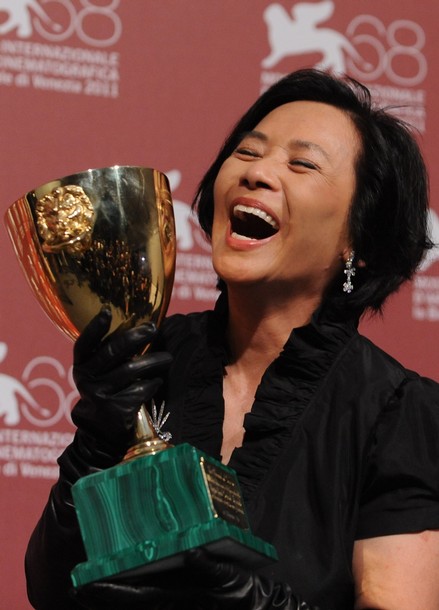
In September, a little Hong Kong film called A SIMPLE LIFE had its world premiere at the Venice Film Festival, and its star Deanie Ip managed to win the Best Actress Award. That began three months of hype, as A SIMPLE LIFE was sent to represent Hong Kong at the Academy Awards (after a week of screenings at a small 30-seat auditorium mainly designated for Friends of the Distributor and the few lucky people quick enough to buy up remaining tickets) and it picked up most of the major awards at the Golden Horse Awards.
However, thanks to the distributor’s apparently unchangeable plan of cashing in on the guaranteed Hong Kong Film Awards nominations (playing it to qualify for the Oscars also meant it qualified for the Hong Kong Film Awards), A SIMPLE LIFE will not be opening theatrically for general audiences until March 2012.
Bring back the spirit of Hong Kong cinema - GALLANTS
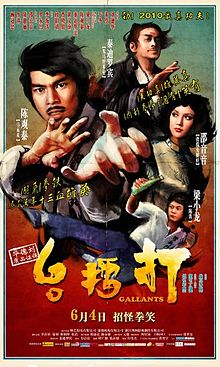
On the night of April 17, many expected IP MAN 2 and DETECTIVE DEE to sweep the Hong Kong Film Awards. However, in addition to Pang Ho-Cheung finally winning an award, a little local film called GALLANTS took home four awards, including Best Picture. The Derek Kwok/Clement Cheng film didn’t make much money at the box office, but it has a lot of fans here and abroad due to its old-school sensibilities. In true underdog fashion, GALLANTS managed to become the star of the night, embarrassing IP MAN 2 (which took home two technical awards) and blocking DETECTIVE DEE from achieving FLAWLESS VICTORY after Tsui Hark picked up the Best Director Award that night. What’s the Cantonese equivalent for “boo-ya” again?
Box Office Surprises - America’s not the only foreign invaders at the Hong Kong box office
Coming-of-age comedy YOU ARE THE APPLE OF MY EYE by novelist-director Giddens packed theaters in both its native Taiwan and Hong Kong. While it made a ton of money in Taiwan (in fact, the highest-grossing Taiwanese film of the year if the two SEEDIQ BALE installments are counted as two different films), it shattered box office records in Hong Kong. By New Year’s Eve 2011, it became the highest-grossing Chinese-language film in Hong Kong history. Its theme song was also voted My Favorite Song of the Year at Hong Kong Commercial Radio Music Awards (the most respected Hong Kong music award), and it reawakened the secondary school students in all Hong Kongers as Hong Kong saw a record number of calls made to married ex-girlfriends. OK, that last part was probably made up.
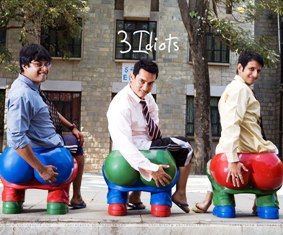
However, 2011’s The Little Film That Could in Hong Kong was Bollywood comedy 3 IDIOTS. Despite scoring huge with audiences at the 2009 Hong Kong International Film Festival, the film didn’t reach general audiences until September 2010, which is understandable since no Bollywood film has ever been given a general release in commercial Hong Kong cinemas. Fortunately, the film was distributed by Edko, who owns Hong Kong’s biggest cinema chain. With a lot of faith on their part and very enthusiastic word-of-mouth, the film continued to play in Edko’s cinema chain for three months. As of the final weekend of 2011, 3 IDIOTS have grossed HK$23 million, outgrossing even ALL’S WELL ENDS WELL 2011 and OVERHEARD 2.
You will pay for my outrageous spending!

Just before the opening of Zhang Yimou’s FLOWERS OF WAR, producer Zhang Weiping decided that not only does he deserve to take a bigger chunk of box office revenue than usual, he also felt that audiences were responsible for paying for his own financial decisions by raising the minimum ticket price for his film by five yuan to 40 yuan (See earlier post here). Cinema chains in China were outraged (more at losing their box office share than raising ticket prices, I’m sure), and the eight major cinema chains in China went as far as threatening to boycott the film.
Despite calling cinemas just “places with empty seats” and justifying the ticket price hike with excuses like “an enhanced product naturally means a higher ticket price”, Zhang managed to call the cinema chains in for last-minute negotiations. In the end, cinemas and Zhang reached a compromise, as the revenue sharing ratio was allowed further negotiations chain-by-chain and the minimum ticket price remained the same. Despite some filmgoers having to pay up to 100 yuan for a ticket (For context: an IMAX 3D ticket cost 120 yuan at peak times, and minimum monthly wage in Shenzhen just got raised to 1500 yuan), people flocked to the Nanjing Massacre drama anyway, and it has now become the highest-grossing Chinese language film of 2011 in China. However, its final gross will still be far below the 1 billion yuan Zhang projected (the film cost 600 million yuan to produce).
As a result of this little fight, the Chinese government is looking to enforce a law that will not allow cinemas to take more than 50% of the box office revenue. This may end up tipping the balance of power back to producers and distributors, as they will surely be taking a larger share of box office revenue once the law passes.
Why download illegally when you can download it legally?

This year saw audiences in China finally catching on to the idea of legal streaming, as traditional pirate video sites Tudou and Youku saw their legal video streaming services take off (region restrictions and all!). However, the biggest one of them all so far must be LeTV, who boasts the largest legally-obtained video library out of all the streaming sites. Offering television series, variety shows, and of course, films, most of LeTV’s content is legal and free (see earlier post here). For the price of letting a little ad pop up on the bottom right of your screen and lackluster audio (their paid service offers HD versions), you can catch the latest Chinese blockbusters on your computer/tablet screens within two months after their theatrical release, and some of them even have English subtitles!
This is terrible news for the Chinese video industry - who is already selling DVDs for as cheap as 15 yuan and has no rental industry due to rampant piracy - but at least it’s a very positive step in getting Chinese people to believe in watching entertainment content in a way that benefits both the consumers (i.e. FREE) and the content providers (i.e. CASH). The next step is getting this technology to people here in Hong Kong, but without the infrastructure and resources that would secure enough profit for content providers, I’m not holding my breath.
With great weibo comes great responsibilities
Twitt-what? The micro-blog that Hong Kong and Chinese people are crazy about this year was Sina Weibo. With the most popular microbloggers getting literally millions on followers (Yao Chen is the Queen of Sina Weibo with 15 million followers), all the cool Chinese celebrities are talking on media platform Sina’s own version of Twitter. Despite constant threats of censorship, Sina Weibo even became one of biggest source of criticisms against the Chinese government after the high speed rail accident in July.
As for the film world, not only has Sina Weibo become the place for filmmakers and stars to interact with their friends and fans (i.e. get their asses kissed), it’s also allowed them to circumvent the typical press conference-driven promotional plans and release information on their own accord. For example, Pang Ho Cheung and Chapman To actually first announced their WHAT WE TALK ABOUT WHEN WE TALK ABOUT HONG KONG MOVIE project on their respective Weibos, before the film’s official Weibo launched and way before the press began to cover the film.
Also, Sina Weibo allowing anonymity means that several “industry insiders” have popped up with secret insider news. While some proved to be false, many have proven to be right. However, attracting the scorn of many industry people, the insiders’ real identities have been as hot a topic as the gossip they provide. When one of these insiders angered SORCERER AND THE WHITE SNAKE producer Yang Zi (mainly involving him and the film’s star Eva Huang), the former actor exposed his/her real identity - a marketing executive at a competing film company - causing the insider to immediately wipe his/her account clean.
While Tencent (as in the company that created popular messaging program QQ) also launched their own Weibo earlier this year with the promise of stars like Karen Mok, Sina remains at the top of the Chinese micro-blogging world, and it’s only about to get bigger. With more and more promotional effort for films being shifted to Sina Weibo (many major films have their own official Sina Weibo account now), it will likely become a place to watch for those who want to see what’s hot in Chinese cinema.
Of course, there were plenty of other stories, including the REST ON YOUR SHOULDER debacle and Johnnie To hitting the Mainland, that I can’t fit in here. I would recommend you to look on the right side of the blog for the archive to see what I covered throughout 2011, including a lot of detail on each of the topic covered in this entry.
As for this blog, I really did wish I updated at a more consistent basis in 2011, and I really wish I can guarantee that I can update on a more consistent basis in 2012. However, with a day job, social obligations, and other professional obligations in this crazy, fast-paced city, I can’t guarantee anything. I just 2012 will be another crazy year in Chinese cinema, though. Where else would I get material?
Once again, a happy new year to all who read this far, and I wish you all a good 2012!
Posted in feature, China, Hong Kong | No Comments »
Thursday, December 15th, 2011
On December 15th, the biggest box office battle of 2011 in China begins with Tsui Hark’s FLYING SWORDS OF DRAGON GATE and Zhang Yimou’s FLOWERS OF WAR opening in Chinese cinemas (Derek Yee’s THE GREAT MAGICIAN was slated to join the battle, but has since backed off to January 12th). It’s the climax of what will be another intensely competitive year-end period in Chinese cinema (last year saw year-end king Feng Xiaogang surprisingly beaten by Jiang Wen). This entry will look at each of the major contenders, and why they will and won’t be hits:
THE FLOWERS OF WAR
Release Date: December 15, 2011
Why it’ll be a hit: Zhang Yimou, one of the most acclaimed directors in the history of Chinese cinema, making the most expensive film in the history of Chinese cinema. Set in the Nanjing Massacre (or Incident, if you’re in Japan), the film, which is also based on a popular novel is promising plenty of large battle scenes. It’s also one of the first Chinese films to feature a major Hollywood star (Christian Bale) as the lead, and it’s representing China at this year Best Foreign Film race at the Oscars.
Why it’ll not be a hit: Its US$90 million price tag already pretty much guarantee that it will not be making its budget back in China (It’ll have to gross at least US$180 million in China alone to break even - government takes roughly 8% as tax, and cinemas take about 55% of the after-tax gross - and that’s not even counting advertising).
Zhang Yimou has also been battling a less-than-great reputation among Chinese film fans after CURSE OF THE GOLDEN FLOWER and A SIMPLE NOODLE STORY (among other various gossip), and the way the film has been sold - with emphasis on sex scenes, Christian Bale, and spectacle - being called insensitive by some won’t help his cause. Also, the very public fight between Zhang’s producer Zhang Weiping and cinema owners in China (and the high ticket price that will result from it) may turn some away as well.
Meanwhile, Christian Bale might have been a good name to sell to potential investors and overseas distributors, he isn’t exactly a household name in China, with neither of his BATMAN films having been shown theatrically in China (though I’d assume that many people have seen them anyway).
Lastly, the film isn’t in 3D, unlike….
FLYING SWORDS OF DRAGON GATE
Release Date: December 15, 2011
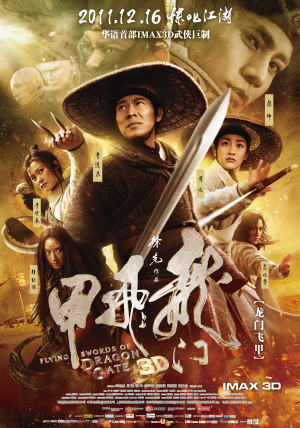
Why it’ll be a hit: Tsui Hark managed to make the highest-grossing film of his career with DETECTIVE DEE (correct me if I’m wrong here), and now he’s making one of the most expensive films of his career with his first 3D Wuxia epic (US$35 million price tag). It’s been well publicized that Tsui is so devoted to making the 3D technology work that he made a feature film as a test film. His producers also made a wise move by striking a deal with IMAX to make it the first ever Chinese IMAX 3D film. Polybona has also moved GREAT MAGICIAN out of the way to make sure it’s one of the only two games in town on its opening weekend (MAGICIAN will go against Huayi’s VIRAL FACTOR instead).
When judged against FLOWERS OF WAR, the action and 3D make it an easier sell overseas than a film about the Nanjing Massacre. Of course, it also has a bigger cast than FLOWERS OF WAR, with Jet Li, Aloys Chen, Zhou Xun, and pop star Li Yunchun.
Why it’ll not be a hit: Not everyone can afford to pay 3D ticket prices, especially when IMAX prices will be up to 120 yuan. Also, there has been a decrease in the popularity of period action films, as evident in the disappointing grosses for LOST BLADESMAN and WU XIA this year.
And now, the dark horses:
DEAR ENEMY
Release Date: December 23, 2011

Why it’ll be a hit: Actress-filmmaker Xu Jinglei made history when her GO LALA GO became the first Chinese urban romantic comedy to pass the 100 million yuan mark at the Chinese box office. Her and LALA co-star Stanley Huang are back in another romance (is there even any comedy in this) about the dog-eat-dog business world, which will likely bring in urbanite women and their boyfriends. In addition to shooting on location in Hong Kong and London, Xu has also gotten a bigger cast this time around, adding Hong Kong stars Gigi Leung, Aarif Lee, Christy Chung, and the legendary Michael Fitzgerald Wong.
Why it won’t be a hit: It opens a week after FLOWERS OF WAR and FLYING SWORDS, which means cinemas are not likely to give it much screenings if both films continue to pack houses. GO LALA GO was also not particularly well received by some, who criticized Xu for putting in too much product placements and straying too far from the source material (Xu, however, has guaranteed that DEAR ENEMY will have fewer product placements).
THE ALLURE OF TEARS
Release Date: December 22, 2011

Why it’ll be a hit: The ensemble cast skews towards a slightly younger audience than DEAR ENEMY. Tearjerkers actually do attract audiences in China (Look at AFTERSHOCK and IF YOU ARE THE ONE II), though the actors here are not exactly known for their impeccable acting skills. Christmas is considered more of a romantic holiday than in the west (like in Japan. Ah-ha, China!), which means this will also bring in lots of couples.
Why it won’t be a hit: Like DEAR ENEMY, it may have problem getting enough screenings in certain cities. No one in the cast can be considered a box office dra, and the same goes for the Barbara Wong/Lawrence Cheng team. Some people may get turned off by the “You will definitely cry” promotional campaign, as well as how closely the poster resembles the poster for the Korean film SAD MOVIE.
SPEED ANGELS
Release Date: December 28, 2011
Why it’ll be a hit: It features a very strong female cast (Rene Liu, Tang Wei, and Cecilia Cheung), and its topic of car racing can be considered fresh in the Chinese commercial film industry. Also, its December 28th release date sets enough distance from the big films that it may be the only big game left in town people haven’t seen.
Why it won’t be a hit: If all four films above turn out to be hits, it’ll be tough to secure enough screens for a big opening weekend, especially since a wave of Lunar New Year films will start in less than two weeks. Jingle Ma isn’t exactly a guarantee of quality for film fans anywhere, especially since everyone’s dressed in purple uniforms and the trailer is promising more melodrama than real racing. Plus, three words for Cecilia Cheung: Box office poison.
There are other smaller films released during the period, but these are essentially the big contenders for December. Of course, it would be great for the industry if all of these films do well, but you know the thing about free market is that people actually will watch what they want to watch and download what they don’t want to watch. Either way, I’ll be keeping a close eye on this box office battle and provide updates and analysis later on.
Posted in feature, China, box office | No Comments »
Monday, November 21st, 2011
I guess since I’ve done a couple of entries about movie going in China already, I might as well turn my movie-going journeys outside of Hong Kong and the United States into a series (my next stop is Japan, by the way).
You can see previous China movie-going exploits here:
Part 1 - Urumqi
Part 2 - Shenzhen: UA KKMall
Part 3 is still Shenzhen (It’s the most accessible Mainland Chinese city from Hong Kong), except this time, I paid a visit to Orange Sky Golden Harvest Shenzhen, in MixC mall:
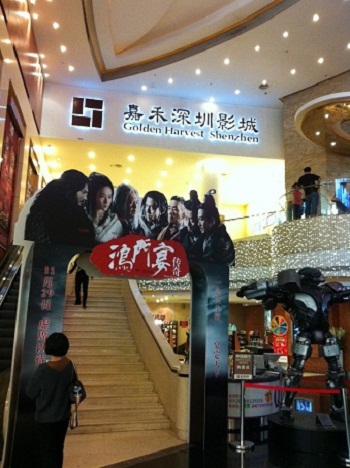
Opened in 2005, the 7-screen multiplex took on a major expansion in 2009, adding five additional screens with digital projection (there’s also a premium auditorium for 230 yuan a ticket). I didn’t just pick this cinema because of its vicinity to KKMall (same subway station, different sides), but also because this 12-screen multiplex is consistently one of the top ten highest-grossing cinemas in China. And let me remind you, China is a BIG place.
I watched two films here today, both on screens at the expansion side: the real-life mountain biking adventure KORA and the mega-hit romantic comedy LOVE IS NOT BLIND.
While the cinema boasts state-of-the-art projection and top-level comfort (for 65 and 75 yuan tickets, they better be right), I actually found OSGH a bit of a disappointment. My biggest problem was the seating, which is not only less comfortable than those of most Hong Kong multiplexes, my bottom began to hurt about an hour into both films, which is inexcusable for auditoriums that were built in 2009. Also, while KORA’s digital print looked fine, the digital print for LOVE IS NOT BLIND - playing in the biggest house with the supposed Sony 4k projector - was a bit too dark for comfort. I can’t say anything about sound, since neither film is exactly an audio powerhouse.
However, OSGH Shenzhen does beat KKMall in terms of location. Not only is MixC connected directly to the Grand Theater Station via an underground tunnel, MixC has both a Starbucks AND a Pacific Coffee, especially important when tickets have to be picked up an hour ahead of time at the latest. MixC is also a lot bigger (it houses a small skating rink) with more food choices. Despite being an early Sunday afternoon, the Pacific Coffee one floor above the cinema (at the Northwest corner) is practically empty and has free wi-fi without any China Telecom hassle (more on why this is important in a bit).
Nevertheless, it’s the quality of the cinema that counts, and that may be why I won’t be returning to Golden Harvest unless I have to.
Meanwhile, some updates from part two about China movie-going that you should watch out for:
Groupon deals: Cinemas have been selling groupon deals, and bargain-hunting Chinese audiences have been eating it up in bulk. Since such deals cannot be redeemed via online ticketing, they’re causing large lines at cinema box offices. Golden Harvest has been wise enough to set separate box office counters for groupon deals, but UA KK Mall was not as wise. If you’re not planning to order your ticket ahead of time, get to the box office early.
Picking up your ticket: If you do book your seats online ahead of time like I do (look at part 2 for more details), know that the cinemas are serious about canceling your booking 60 minutes before the film starts. I arrived at UA KK Mall at 10 am to pick up my 10:30 TIN TIN tickets (the mall doesn’t open til 10 am), and after spending 15 minutes in line (thanks to the groupon people), my seat was canceled and sold already. Luckily, I was able to pick another seat because the showing wasn’t full.
Wi-fi: If you do have to arrive at the cinema to pick up your ticket, you’re going to have at least an hour to spare. I like to go get a cup of coffee (it’s a long trip up to Shenzhen), which means I usually go to Starbucks. Back in July, I was able to access the free wi-fi in the store and get to Twitter and Facebook via the VPN connection I had already set up on my phone. However, China Telecom now require users to register their cell phone numbers before using the wi-fi, so my Hong Kong number didn’t work.
However, Pacific Coffee’s free wi-fi simply requires you to put in a password that is displayed prominently on the store counter, which means I had no problem getting wi-fi at Pacific Coffee. So if the place you’re going to only has a Starbucks, bring a good book.
Audiences: Watching KORA in China felt like I was in someone’s living room watching TV. Everyone has something to say about the film, and there’s no way you can shut everyone up. Talking, texting, phone calling at the movies in China is a commonplace, and while it shouldn’t happen, you will have to accept it as part of the movie-going experience in China. Of course, I can’t do it since I went to the movies alone, but as the old saying goes: If you can’t beat ‘em, join ‘em.
English subtitles: Last time I was in China, neither REST OF YOUR SHOULDER nor WU XIA had English subtitles. This time, both KORA and LOVE IS NOT BLIND had English subtitles (though LOVE’s English subtitles were so bad that it’s not worth the visa to go to China to catch it if you’re relying on it). There’s no set rules, so you’ll have to rely on luck on this issue.
There are plenty of big blockbusters opening in December and Lunar New Year in China, so I hope this guide will be of use to those planning to visit a Mainland Chinese cinema during the holidays. Next time, I hope to go to the cinema in the Shenzhen Music Hall, and that’ll likely happen in December.
Posted in feature, China | No Comments »
Monday, August 29th, 2011
With talk about the box office battle looming in China come December, it’s a good time to do a focus story about the art of scheduling movie releases in the Greater China area:
- As i had mentioned in an earlier entry, this summer has not been a particularly great one at the movies here in Hong Kong. The thing is that it hasn’t been that great in China, either, as BEGINNING OF THE GREAT REVIVAL, WU XIA, and MYSTERIOUS ISLAND have been the only three major stories all summer. This may baffle those who are used to the usual summer tradition around the world, with the biggest, loudest blockbusters rolled out to make money from kids out of school on holiday (high weekday grosses).
While the vacationing kids audiences is big in China, high ticket prices means that the movie going audience tends to skew a little older, which means that big filmgoing periods are more likely to coincide with big holiday periods when people don’t have to work.
There are essentially four big release periods in China that every distributor of major blockbusters in China want to get their hands on: Lunar New Year, Golden week in May, National Day extended holiday in October, and mid-to-late-December. Since the summer is when Hollywood blockbusters dominate the global box office, the summer is not a huge release period unless you have something big enough to compete.
Case in point: Out of the top ten grossing films in China in 2010, only two films were not released during those four periods - AFTERSHOCK was big enough to take on the summer, and UNDER THE HAWTHORN TREE was released a week before the National Day holiday rush began with LEGEND OF THE FIST.
Three of those periods are pretty self-explanatory when it comes to why they’re huge for filmgoing - Instead of long weekends, China’s holidays are clumped into longer batches because it allows time for workers in big cities to return home to visit their families. Extended holidays also mean theaters and distributors are blessed with consecutive days of high box office gross, which also means plenty of good publicity for the films as well.
However, the period that baffles even me is the December period. The so-called “year-end celebratory” period has long been where Feng Xiaogang reigns as king (ever since his SORRY, BABY in December 1999, only THE BANQUET was not released during that time), and that’s when China made so many major blockbusters that it’s become the place where Zhang Yimou and Feng Xiaogang earn top box office dollars with films like HERO, THE ASSEMBLY, IF YOU ARE THE ONE, and CURSE OF THE GOLDEN FLOWER. In 2010, the period saw its most intense competition yet with a direct battle between Jiang Wen’s LET THE BULLETS FLY and Feng Xiaogang’s IF YOU ARE THE ONE 2. While BULLETS came out on top, IF YOU ARE THE ONE 2 also made 473 million yuan, Feng’s second highest-grossing film after AFTERSHOCK.
That battle is about to get even more intense this year, with three big films already locked to duke it out in the same week in mid-December: Derek Yee’s THE GREAT MAGICIAN (Tony Leung + Lau Ching Wan + Zhou Xun), Tsui Hark’s IMAX 3D FLYING SWORDS OF DRAGON GATE (Jet Li +wuxia + 3D), and Zhang Yimou’s NANJING HEROES (big budget +rumored IMAX release + Batman!). There’s even word that Wong Kar Wai’s GRANDMASTER may be trying to make that release date as well.
But why? and how? December sees no major holidays in China (I’m pretty sure they don’t get Christmas Day off over there), and yet, that’s when the year’s biggest films (yes, even bigger than Lunar New Year) are rolled out. But at least now you know why all the talk in Chinese cinema right now is concentrating on that all-important December period. If your film is there, you’ve hit the big time, baby.
- China has three major film awards - The Golden Rooster Awards, the voter-based Hundred Flower Awards, and the Huabiao Awards. Held by the State Administration of Radio, Film, and Television every two years, the latest edition of the Huabiao Awards has just announced its nominees. The Huabiao is a little unique in that it clearly separates purely Chinese productions and co-productions into two separate categories.
Under “Excellent Chinese Narrative Films”, the 20 nominees include both FOUNDING OF A REPUBLIC and BEGINNING OF THE GREAT REVIVAL, as well as “box office hits” like WENTIAN, GUO MING YI, and WEN SHAN ZHOU. Of course, Zhang Yimou’s UNDER THE HAWTHORN TREE, Chen Kaige’s SACRIFICE, and Feng Xiaogang’s AFTERSHOCK are included. Even GO LALA GO managed a nomination.
Meanwhile, 8 co-productions are nominated for “Excellent Co-Produced Film” - CONFUCIUS, IP MAN 2, BODYGUARDS AND ASSASSINS, ECHOES OF THE RAINBOW, DON’T GO BREAKING MY HEART, OCEAN HEAVEN, REIGN OF ASSASSINS, and…….THE MESSAGE?!
10 other films were also nominated for “Excellent Digital Film”, but those are just small productions that no one really cares about.
Only two foreign films were recognized in the nominations - AVATAR and INCEPTION. Those who care, raise their hands? OK, moving on.
WENTIAN, the astronaut film produced by the People’s Liberation Army’s August 1st Studio (Last I heard, they were making an inspiration sports film about their basketball team), scored the most number of nominations - with “Excellent Film Techniques”, Best Script, Best Director, Best Actor in addition to its best film nod. I can’t wait for that WenTian sequel, which might be some twisted, communist propaganda version of STAR TREK. Yes, soon, the PLA will be liberating the oppressed people of space from the evils of the intergalactic Kuomintang.
For those who still care, the awards were held on August 28th, and 10 out of the 20 nominated films were recognized for best films. They include REVIVAL, AFTERSHOCK, REPUBLIC, WENTIAN, GUO MING YI, WEN SHAN ZHOU, and HAWTHORN TREE. Meanwhile, WENTIAN and REPUBLIC picked up Best Director (s), REVIVAL won Best Screenplay, both Ge You (for SACRIFICE) and YANG SHAN ZHOU’s Li Xue Jian won Best Actor(s), Sandra Ng won Best Overseas Chinese Actress for ECHOES OF THE RAINBOW, and Chow Yun Fat picked up Best Overseas Chinese Actor for CONFUCIUS.
Notice one important omission? Yes, LET THE BULLETS FLY was completely ignored.
The complete list of winners (in Chinese) can be found here.
Not much for an entry today, but I promise Chinese box office and other gossip in the Chinese movie scene next time.
Posted in feature, China, awards | No Comments »
Sunday, August 7th, 2011
Today is what is known as Chinese Valentine’s Day. So what better way to spend the night than to write a blog entry?
Like many other places in the world, summer is when Hollywood shines in Hong Kong cinemas. With films like TRANSFORMERS and HARRY POTTER dominating literally more than half of the city’s multiplex screens, it’s hard to imagine any big local/Chinese-language films having the guts to compete.
However, there have always been a few tentpoles that is able to attract audiences over the years - INITIAL D, STORM RIDERS, INVISIBLE TARGET, and RED CLIFF. Even in 2010, we saw a good share of Chinese-language (co-production) blockbusters (regardless of their quality) like STOOL PIGEON, TRIPLE TAP, CITY UNDER SIEGE, AFTERSHOCK. Even BREAK-UP CLUB made a nice chunk of change for a film in its genre.
And now, here we are in 2011. Between June 1 and September 1, Hong Kong cinemas only have these Chinese-language films getting wide releases: MICROSEX OFFICE, TREASURE INN, BEGINNING OF THE GREAT REVIVAL, BEACH SPIKE, LOVE IS THE ONLY ANSWER, WU XIA, FORTUNE BUDDIES, OVERHEARD 2, SUMMER LOVE, and THE WOMAN KNIGHT OF MIRROR LAKE. By this week last year, AFTERSHOCK and BREAK-UP CLUB already managed to break the HK$10 million mark at the box office.
On the other hand, from June 1 to August 6, 2011, none of the Chinese-language films listed above managed to reach that mark yet. Even WU XIA, the most likely candidate, will likely only gross HK$8 million when its theatrical run is over.
So, what the hell happened? Not to undermine GREAT REVIVAL and TREASURE INN, but there has been a clear lack of tentpole this year here in Hong Kong, with audiences all flocking to Hollywood films for their fix of spectacle, dimmed 3D projection, and pretty foreigners. Instead, we get low-budget Hong Kong productions made for audiences under the age of 25. While we saw LA COMEDIE HUMANIE do moderately well last year, the only adult-skewing comedy Hong Kong has to offer this summer is MICROSEX OFFICE.
It’s China’s fault.
Opening mid-June, BEGINNING OF GREAT REVIVAL essentially cleared the path for most Chinese blockbusters in Chinese cinemas, including Hong Kong-China co-productions. Granted, Lunar New Year and December are actually Chinese cinema industries’ strongest periods, but at least we got Benny Chan’s big-budget mutant movie and Derek Yee’s “I’m selling out to China” action films in 2010.
Instead, China opened smaller, local-oriented productions like LOVE FINALLY, THE DEVIL INSIDE ME, PRETENDING LOVERS, and MYSTERIOUS ISLAND, with WU XIA being the big tentpole in July. There was also the big-budget, China-oriented fantasy REST ON YOUR SHOULDER, which flopped due to it being distributed with little promotion and it sucking.
Instead, MYSTERIOUS ISLAND scored big, making 80 million yuan all thanks to young audiences not interested in WU XIA and a young starlet named Mini Yang. Even the PRETENDING LOVERS made a decent amount of change at 31 million yuan, which is not bad for a film starring Huang Bo and a director who got so fired that he was literally just credited as the “pre-production director”.

Yes, this immense talent(s) put more asses in Chinese cinema seats than Jordan Chan and Hiro Hayama combined. Really.
However, what appeal do films like MYSTERIOUS ISLAND, PRETENDING LOVERS, and REST ON YOUR SHOULDERS have for us Hong Kongers? None - as PRETENDING and REST have yet to have any Hong Kong release date, while MYSTERIOUS ISLAND only got a small, seven-screen release (Mei Ah probably wasn’t even interested in booking more cinemas than seven). As a result, cinemas needed low-budget comedies like SUMMER OF LOVE, BEACH SPIKE, LOVE IS THE ONLY ANSWER, and MICROSEX OFFICE to fill the gap. I suspect that the combined budget for these films don’t even pay Donnie Yen’s salary on WU XIA.
It’s Hong Kong’s fault.
As mentioned earlier, Barbara Wong’s BREAK UP CLUB was the surprise hit in summer 2010, and even MARRIAGE WITH A LIAR managed to turn a profit in Christmas 2010. What’s a film investor to do but to invest in films that attract vapid, young consumers who have to leave the house, but need an air-conditioned venue to pass the time? That’s where BEACH SPIKE, LOVE IS THE ONLY ANSWER, and even SUMMER LOVE (which ironically opens 6 days before the school year starts) all come in.
However, what the producers didn’t anticipate was that many films avoided the double-whammy of TRANSFORMERS and HARRY POTTER, allowing the two to take up so many screens that it could fit in all the audiences that wanted to flock to them. Also, producers didn’t realize that the demographic they were trying to appeal to was also the most likely demographic that would download these low-budget films on their computer/iphones/MP4 players because, well, they look like they deserve to be played on those platforms. In fact, these films were made at such a low budget that LOVE IS THE ONLY ANSWER is already considered successful at its currently HK$5 million gross.
While people like to blame China and its money for the lack of Hong Kong-oriented productions worth watching, it was also Hong Kong audiences who marginalized themselves with their viewing behaviors and tendency to turn to the cheapest way to get anything. When BODYGUARDS AND ASSASSINS made 320 million yuan in China, it only made HK$15 million in Hong Kong. When OVERHEARD made 86 million yuan in China, it also made just HK$15 million. Where were Hong Kong audiences for films like ISABELLA, WRITTEN BY, GALLANTS, ONCE A GANGSTERS, and ACCIDENT? When Chinese audiences became so much more receptive to films by Hong Kong filmmakers than audiences of their own home, can you blame these Hong Kong filmmakers for having to look up north? Hong Kong filmmakers are trying to make a living, too, and they will go where they can survive, because seriously, when will Andrew Lau and Gordon Chan ever make a film for its artistic merits?
Before you get ashamed of having Patrick Kong using labels like “support Hong Kong cinema” as a selling point for his next crappy idol-driven romantic comedy, ask yourself, what have you done to prevent that from happening by supporting the good films that ought to be representing Hong Kong cinema?
It’s Hollywood’s fault.
Comic-book heroes, magical wizards, and fightin’ robots are all that we’ve seen here in Hong Kong this summer, and it’s not only because the audiences asked for them - it’s because the distributors demanded it. Distributors of major Hollywood blockbusters here in Hong Kong, knowing their clout over multiplexes, reportedly force cinema chains to follow terms like not cutting shows in the first week and demanding them to carry 3D versions in order to cash in on the higher ticket prices. Instead of lowering the number of 3D screens for a more balanced ratio between 2D and 3D versions, these films simply took up even more screens to fit in limited showings of 2D versions.
In fact, the reason that WU XIA had to open three weeks late in Hong Kong was because it simply wouldn’t be able to withstand TRANFORMERS and HARRY POTTER, and We Pictures felt it needed a two-week gap to even make a dent. That’s how afraid we are these days.
No matter whose fault it is, I think it’s pretty accurate to say that Hong Kong cinema in the summer of 2011 has sucked. It’s a vicious cycle - you make movies that no one wants to see, then no money comes back to you. You have no money to make the next movie, so you go to another place that’ll have money for you. Perhaps this may also shed some light on why the blog has such a heavy China focus now - While Apple Daily puts up daily reports of scandals from Miss Hong Kong, Chinese reporters are busy going to one press conference after another, actually reporting news about THE FILMS. Regardless of how many shady practices are going on behind the scenes of those press conferences, at least people are actually informing people about the movies, not the gossip.
Of course, there’s also the idea of scheduling to deal with, but that’ll be a focus story some other time.
- Speaking of press conferences, CRAZY RACER/STONE director Ning Hao has finally unveiled his latest film to the press. His most expensive film to date at 50 million yuan, HUANG JIN DA JIE AN is another heist film, this time taking place in 1930s Manchuria. That means expect double-crosses, nice period set designs, and of course, evil Japanese people. While the cast is mostly new actors with little experience, Huang Bo also will have a small role in the film.
As for NO MAN’S LAND, his desert heist film that is still stuck in distribution limbo, Ning Hao only said that production on the film has finished a long time ago, and that the production company is responsible for its distribution. This is why he felt he was free to move on to another film.
Meanwhile, insiders tell me that those who saw it said NO MAN’S ZONE is great, but it’s likely that it’ll be stuck in censorship limbo for a while.
- Here in Hong Kong, director Herman Yau also unveiled his latest film, produced by prolific local producer Ng Kin Hung (GIRL$, HI, FIDELITY). It’s a romantic comedy starring Chapman To, Elanne Kwong, and Tien Niu. Chapman and Elanne will be playing husband and wife, so you already know it’s a comedy. The film just began shooting, and knowing Yau’s efficiency, it’s probably in the editing room already.
Seriously, though, it’ll probably be out by the end of the year.
- Both Zhang Hanyu and John Woo’s representative have pretty much confirmed that John Woo will be shooting a film based on the sinking of the Taiping instead of FLYING TIGERS at the end of the year. In addition to Zhang, Korean actress Song Hye-Kyo will be co-starring as Zhang’s wife. With a real-life ship sinking and a love triangle as its core, it’s no surprise that this is being dubbed as the “Chinese TITANIC”.
- In more production news, I reported earlier about Chen Kaige’s next neorealism project will start shooting in September. More details have emerged, revealing that it’ll be a drama about internet bullying that’s based on an internet novel. The film will be shot while sets are being built for his big-budget fantasy project, and insiders say that the small-scale film will star Ge You and Yao Chen.
- I also reported earlier that director Wang Quan’An’s latest will not be making it to Toronto and Venice. At a retrospective of his films in Beijing, Wang revealed that he has completed editing a rough cut of his latest film WHITE DEER PLAIN. Initially five hours long, Wang managed to cut another hour out of the film after his honeymoon with wife/the film’s star Kitty Zhang, and the current four-hour cut is being submitted to censors. After it’s approved, Wang will likely take another crack at cutting it to a manageable length. The film will be released in October at the earliest.
Meanwhile, Wang’s award-winning APART TOGETHER still hasn’t been distributed in China in cinemas nor video (though it was screened at the retrospective). What’s the hold up??!!
- Those who still care about box office: HARRY POTTER 7.2 finally opened in China, and unofficial figures put it at a 48 million yuan opening day. That means it’ll beat 7.1’s first weekend gross of 81 million yuan in two days. It won’t beat TRANSFORMERS at this rate, but it’ll probably make around 400 million yuan, which means it will also beat BEGINNING OF THE GREAT REVIVAL at the box office. Meanwhile, a Weibo insider also noticed a huge surge in the box office for YANG SHAN ZHOU (one of the propaganda films) on the day of HARRY POTTER’s opening. Make what you will out of that on your own.
- The head of Xiangtan City’s Bureau of Radio, Film, and Television in Hunan Province wants to make a big-budget outdoor production of a Mao Zedong biopic, and he wants some western production values for his play. To achieve his goal, he took to his Weibo (he has a verified account), and literally wrote this:
“Can anyone help provide the contact information for Canadian director James Cameron? His films TITANIC and AVATAR set new records at the box office records. The recently-established Shaoshan Red Culture Tourism Group is currently looking for collaborators to produce a big-budget outdoor production of ZHONG GUO CHU LE GE MAO ZEDONG (Literally “China Made a Mao Zedong”), and I want to hire him as a creative consultant. Please provide, please repost. Thanks!”
Within a day, the message was reposted 37,000 times, with 15,000 comments, most of those ridiculing the poor government official of trying to be funny. Finally, a netizen posted a phone number for what he claims to be James Cameron’s production company. However, Lightstorm Entertainment said they haven’t heard anything about this possible collaboration.
In case you don’t know, Xiangtan is the hometown of several Chinese Communist Party founders, including Mao himself.
Next time: THE HORROR, oh, THE HORROR in China, and more.
Sources:
M1905 1
M1905 2
Mtime
Sina 1
Sina 2
Sina 3
Sina 4
Posted in actors, feature, media, humor, China, Hong Kong, news, Hollywood, box office | No Comments »
Wednesday, July 27th, 2011
There’s a lot of real troubles going on in the world that make what I do here seem insignificant. And it’s true - who cares if some theaters are using shady accounting? Who cares about feud about film cuts? Who cares about trailers being posted on the internet? While real journalists out there in Wenzhou and Norway continue to work hard to get to the truth about events that really affected people’s lives, it’s hard to continue on writing as if what this blog does actually matters at all.
Well, it doesn’t.
Nevertheless, we all have our own jobs to do, and my job is to keep presenting issues that are related to this site from as many sides as possible. Sometimes, I may even run into a story that actually matters to people, but most of the time, they won’t matter to more than 50 people out there.
And for some reason, that’s OK.
And now, onto the news:
- With Chinese films often relegated to the arthouse and film festivals in the west, we often forget to see the Chinese film industry as a burgeoning commercial film industry. Chinese filmmakers (and Hong Kong filmmakers looking to the Chinese market) and investors are now experiencing growing pains that Hollywood filmmakers have been dealing with for years. This entry will look at a report of one recent example:
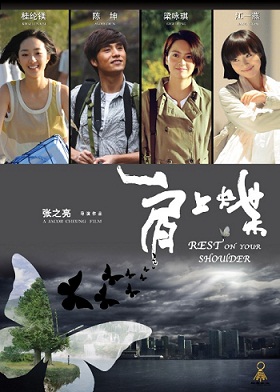
After 2007’s TICKET, Hong Kong filmmaker Jacob Cheung wanted to adapt a web story about a woman who turns into a butterfly to save her boyfriend’s life. That film was REST ON YOUR SHOULDER. The fantasy romance would require a huge budget due to the special effects, a score by Joe Hisaishi, and a shoot that will take the crew to Japan.
That’s where Straw Family came in. Formed in 2008, Straw Family had planned six animated features, one animated series, and six feature films, and REST ON YOUR SHOULDER was to be the film that announced their arrival as an aspiring key player (one animated film and one animated series have been released since). The company’s key investor was an entrepeneur who found his pot of gold in the furniture business, and he trusted Cheung completely because of the director’s extensive experience in the film industry (Cheung also directed CAGEMEN and BATTLE OF WITS). He even allowed Cheung to be labeled as Straw Family’s leader.
Investor Liu (his full name was not revealed) initially gave Cheung 20 million yuan as the film’s budget, but it kept ballooning during the production, and they estimated that they ended up spending 80 million yuan when all’s said and done (fairly high for a director who’s never made a special effects-driven fantasy before), including advertising, Cheung’s fees (he was paid separately salaries for writing and directing), and other expenses.
According to Straw Family staff (which is apparently no longer led by Cheung), Cheung promised them a commercial film that will outdo A BATTLE OF WITS, the biggest commercial project of his career at the time. Cheung even estimated that the film will make 150 million yuan at the box office - not bad for an initial investment of 20 million yuan. At that time, the investor apparently already knew that Cheung is the type of director who refuses to let any production company or producer change his script, but they felt that he was a director worth helping.
The troubles started when Cheung finally delivered a 123-minute film. Shocked at the length, Straw Family and the investor wanted to edit it down to a more audience-friendly 93-minute cut. However, due to the time it takes to edit down the film and get a permit from SARFT, the film would not have been able to make the Shanghai Film Festival. Straw Family insists that it was Cheung, not them, who submitted the film to the festival, and that they only found out about the submission after the film was accepted into the competition. Liu very, very displeased.
According to e-mails Cheung wrote to Straw Family, he argued that the two-hour length of recent Chinese blockbusters like LET THE BULLETS FLY, DETECTIVE DEE, and even his own BATTLE OF WITS did not affect box office performance. He admitted that he had no power to stop Straw Family from cutting it, but he flat out refused to participate in the editing process. He also wrote that to keep quiet about the situation, he would simply bow out of all promotional efforts for the film and remain in Canada, where his family lives.
The problem, the investor said, was that the 123-minute cut wasn’t screened for them until the day before it had to be submitted to the censors. This means that they wouldn’t have had enough time to get the 93-minute cut to the Shanghai Film Festival, and they weren’t confident enough about the cut they were screened to show to the world. To the press, they said that they wanted to film cut to fit in more shows. However, in reality, Straw Family wanted to cut the film because they thought they had a stinker on their hands.
Distributor Gao Jun is on the investor’s side, saying that the 93-minute cut actually plays a lot better and would’ve resulted in a higher gross. He knew that Straw Family didn’t want to fight Cheung to the end, but he said he would’ve insisted on the 93-minute cut if he was the investor because he knew that was the superior cut that would’ve helped him make his money back. Gao didn’t comment too much on the feud itself, but he warned benevolent investors to spend their money wisely.
And the rest was history: When Straw Family and Gao Jun announced they would be releasing a 93-minute cut in theaters at the Shanghai Film Festival, Cheung himself announced he would withdraw from all promotional activities for the film, including his scheduled appearance at the festival. Originally the opening film, Straw Family withdrew the film from the opening slot, though the film remained in competition. The company then arranged for the competition screening in a small auditorium (all other competition films played at the larger auditorium in the same multiplex) and screened the film for a very small audience.
Finally, Straw Family relented after the press began reporting what was happening and announced they would show Cheung’s preferred 123-minute cut in theaters. But two weeks before the opening of the film, Cheung complained on his weibo that the distributor didn’t contact him to do any promotion on the film (the premiere was also canceled, citing “talent unavailability), and the film ended up flopping at the box office with only a 11 million yuan gross.
As for Cheung, the reporter managed to get a hold of his spokesperson. In his defense, the spokesperson said that Straw Family never communicated with Cheung about needing edits and edited the film without him knowing. She also said that despite Straw Family’s claim that they didn’t get the commercial film they were promised, REST ON YOUR SHOULDER is actually Cheung’s most commercial film yet. She finally said that it’s unfair for Cheung to take the full responsibility for the failure of the film and suggests that Straw Family is at fault as well.
So, what can we learn from this mess?
1) The power of the investor. Straw Family claimed that the investor essentially allowed Cheung to do whatever he wanted, until the finished product wasn’t what they wanted. They claimed that Cheung never signed an official agreement with the company, which meant that they had the right to do whatever they wanted with the film. However, that also meant that Cheung was able to just bow out of promotional activities as he wanted. The story paints Straw Family and investor Liu as the victims in this case, and this should at least serve as a warning to future investors that they should set clear terms and conditions on paper about what they can and cannot do. On the other hand, there are probably not many investors as kind as Liu, and they will impose many impossible terms on a filmmaker. Agreements on paper hopefully can control that issue as well.
2) The power of the director. Should Cheung have stood firm on his position and refused to compromise? If he’s the one that will be taking credit for the film’s success, should he be taking all the blame for its failure as well? From my personal opinion, the film was really overlong, and someone should have guided Cheung from the script stage to final cut. Problem was Cheung was acting as his own producer. So this brings us to:
3) The power of the producer. A bad producer compromises a director’s vision and a film for the sake of personal taste, but a great producer can help rein in a director’s vision for the sake of the film. From this and the case of PRETENDING LOVERS (director fired and had credit taken away, film cut by 15 minutes), it’s clear that a gap is widening between investors (especially those with personal interests) and directors (especially those who think they’re auteurs). A great producer can step in and fill this gap. Derek Yee, Chen Kuofu, and Peter Chan make great producers because they happen to be filmmakers who have also dealt with investors, meaning they can be excellent middlemen who can serve in both sides’ interests.
When people win film awards, they always say that making a film is a collaborative effort, and that’s truer than ever in the case of the Chinese film industry. Egos will always clash, but filmmakers, investors, distributors, and producers all have to work to find a compromise that serves the films. Otherwise, the only true loser will be the paying audience.
- Time for a quick look at the Chinese box office. As mentioned in the previous entry, TRANSFORMERS 3 pretty broke all box office records in China - best opening day, best midnight show grosses, best single-day grosses. According to figures from entgroup, Michael Bay’s crazy robot movie made 401 million yuan in the first 4 days. Despite a very high 42 yuan per ticket price, the film had an amazing 90.4 admissions per show.
However, the most interesting thing on the chart is WENTIAN’s amazing jump to fifth place. If you remember, WENTIAN is one of the three “excellent recommended films” that is commemorating the Chinese Communist Party’s 90th anniversary. The film’s 5.3 million yuan gross in the last seven days may look like nothing, but not only is it 660% higher than the previous week’s gross, it also has 90 admissions per show (compared to 54.4 the previous week). How is this possible for a film that’s been in cinemas for over three weeks? Well, you can probably guess.
Elsewhere on the chart, WU XIA is now at 169 million yuan, which means it’ll beat THE LOST BLADESMAN, but not by much. LEGEND OF A RABBIT now at just 15.9 million yuan after two weeks, making is a massive failure considering its reported 100 million yuan-plus budget. TO LOVE OR NOT finally makes it to the top ten, but its total after ten days is only 5.85 million yuan. Congratulations to both MYSTERIOUS ISLAND and TREASURE INN, which have broken the 80 million and 100 million yuan mark, respectively.
- Gao Xiaosong’s MY KINGDOM, starring Han Geng, Barbie Hsu, and Wu Chun has pushed back its release date from August 12th to September 9th. This is actually a programming move to get it into the Mid-Autumn holiday weekend, and it will go directly against romantic comedy LOVE IN SPACE.
- The Wenzhou-based investor of the heist comedy COMING BACK, starring Simon Yam, has announced that it will announce all of its box office proceeds from July 26th onwards to the victims of the recent rail accident in Wenzhou. Problem is the film has only made 8.15 million yuan after 10 days, and it isn’t poised to do much business after July 26th.
- Macau will finally get its first multiplex, courtesy of Hong Kong’s UA Cinemas. According to a friend from Macau, the cinema scene there is dreadful, and anything with more than three houses (with two houses actually working) will be better than what they have right now. Bad news for Macau residents is that it’ll be in a casino rather than a truly accessible part of town.
Next time, how the Chinese press explain why BEGINNING OF THE GREAT REVIVAL under performed at the box office.
Sources
Entgroup
Entgroup 2
Film Business Asia
Mtime
Sohu
Sina
Posted in feature, media, gossip, China, Hong Kong, box office | No Comments »
Monday, July 11th, 2011
- Before getting into the focus story today, Sina News just posted a story about WU XIA’s box office in China:
According to the story, the film only made RMB 92 million in the seven days, which co-investor Stellar Megamedia’s CEO admits to being disappointed by. However, he also points out that the film already took up 50% of total box office gross in China this past week, which means that people just aren’t going to movies. He also believes that the recent box office gouging scandal has only minimal impact (more on that later), and that there are bigger factors at play here.
We Pictures marketing head Mr. Lu also admits to being disappointed with the gross, especially its weekend gross. He says total box office in July so far is “outrageously low” compared to the same time last year. However, Lu also says that with overseas sale, the film will eventually find its way to profitability. More analysis of WU XIA’s box office when figures come out in a day or two.
- Today’s focus story is on internet distribution for films in China. In January 2011, LET THE BULLETS FLY premiered on Chinese video sites such as Youku, Tudou, and others, on an on-demand basis. Essentially, the idea is that you pay RMB 5, and you can watch the film as many times as you’d like within 48 hours. The film was viewed over 200,000 times in 20 days, grossing over RMB 1 million.
With legitimate DVD cost continuing to rise and piracy still rampant, this is the new way of film distribution in China. Basically, a film typically lands on these video sites about a month after their theatrical release. After a paid VIP Zone window, which allows members to watch the film in HD for a small premium, the film becomes free for all members. As of today, A BEAUTIFUL LIFE, NO. 32 B DISTRICT, and LOVE FOR LIFE can all be seen for free already, some with subtitles and some without. These sites also include a large arsenal of television dramas, including all 30 episodes of NAKED WEDDING (trust me, they’re not naked like the way you think they are), which just premiered on one major Chinese regional network tonight.
Only a year or so ago, films were being uploaded illegally by users mainly on sites like Tudou and Youku. These sites pulled off a major cleanup and began acquiring licenses from content owners, which would make sense considering the amount of advertising these deals can generate. LeTV (the site I frequent the most) is one of the leading video sites in China. Not only has it built up an archive of over 4,000 films, it is also the first company of its kind to be traded on the stock market. In addition to a free iPad app, LeTV also sells an Apple TV-like device that streams its archive of films via the internet to television in HD, and they’re planning to sell 100,000 of these things this year. I saw an ad for it when I was in the cinema this past weekend:
Tudou, Youku, and now even CCTV’s movie channel have made mobile apps for easier access to their films.
This is a very similar model to what Apple is doing in the states and Japan with iTunes, opening up more platforms and choices for audiences to watch films legitimately. However, these Chinese film industry is relying on this platform to work more so than the studios in the United States. Due to high ticket prices, cinema going is still considered a luxury for workers who only make about an average of US$500 a month. By making films available at a lower price than pirated DVDs, content owners are taking back any revenue they can in any possible way. As I had predicted earlier, the Chinese film industry is definitely heading towards a bubble situation, but there are things being done to delay that day, and internet distribution is one of them.
However, there are problems that come with this model:
1) There’s no report on the true impact of these technology has on cinema revenue yet, but once there is, cinema owners will not be happy (the previous report about July box office being low may be one of the first signs). Like it or not, cinema revenue is still the best way for films to make money, and on a personal note, I believe that films are made to be seen in cinema. If the cinemas go down, the industry will also be severely impacted in a negative way. The same goes for legitimate video sales. Video publisher already had to resort to releasing inferior DVD-5 versions of Chinese films to make them more affordable, but internet distribution is offering these films at a better video quality for a lower price. With Blu-rays being sold at astronomical prices and DVD sales likely to go way down, the Chinese video market may eventually disappear. As far as I know, there is no legit video rental industry in China at the moment.
2) Rising licensing cost. While smaller films will appreciate that video sites will buy their content, production companies are likely charging more and more for bigger films. One day, these licenses may become so expensive that video sites don’t see the point in shelling out the money for them anymore. The rising cost situation is already happening on the TV drama end, where prices are per episode, not per series.
3) Copyright infringement. LeTV recently filed suit against a manufacturer of a home media center (similar to LeTV’s television box) for allegedly providing access to films that LeTV claims to hold exclusive rights for. The media scene in China is very fragmented right now, with more video sites, television stations, and news outlets than I care to count, which means many different companies sharing content that they might not be permitted of having. This may discourage video sites to pay the big bucks for exclusive rights, or encourage video sites to clamp down harder on enforcing their exclusive rights, as well as extending pay windows. This will have a negative effect on consumers, who may just go back to illegal downloads or buying pirated DVDs.
There are a million directions which internet film distribution in China can go, but I say the more legit ways people have to watch films, the healthier the film industry will be. Sure, a film should be watched in the cinema, but it seems like for now, the masses have spoken, and they say otherwise.
- Following up on the box office gouging story from last week, netizens are still reporting that they’re not getting tickets to films they paid to see. To refresh your memory, audience buys ticket to WU XIA, theater prints a ticket to BEGINNING OF GREAT REVIVAL. Audience watches WU XIA, but money go towards BEGINNING OF GREAT REVIVAL.
Netizens reported last week that this practice is still happening in some cities. The distributor lamented that cinemas are simply saying that their employees made mistakes at the box office and that they can do little more than that. China Film Group continues to deny and decry the practice, while Stellar Media continues its campaign of offering RMB 1000 to each report of box office gouging for WU XIA. Stellar Media says they have already given out RMB 5000, and they have no idea how many more thousands they’ll have to give out.
Weibo reports of gouging have slowed down over the weekend, and I will say that this past weekend, I was given printed tickets for films that I actually bought tickets for, so no RMB 1000 for me.
- TVB/Shaw Brothers’ FORTUNE BUDDIES, spun off from the TVB variety show FUN WITH LIZA AND GODS, completed its 20-day shoot. Star/producer Eric Tsang said the film will only have three days of post-production because it has to go through Mainland censorship before its opening date of August 11th (simultaneous with Hong Kong). This is not the shortest shoot for a Hong Kong film - Johnnie To/Wai Ka Fai’s HELP!! only took 30 days from shooting to hitting cinemas, and director Pang Ho-Cheung shot EXODUS in reportedly 18 days. Go, Hong Kong cinema!
Trailer for FORTUNE BUDDIES here.
And now, today’s edition of WHAT I LEARNED FROM SINA WEIBO:
- Derek “son of Eric” Tsang posted the cover of the script for Pang Ho-Cheung’s reportedly Beijing-set sequel to LOVE IN A PUFF. It revealed two things: the script is co-written by Pang and Hong Kong novelist Lu Yi Xin, and its current English title is LOVE IN A BUFF. No kidding. Tsang wrote that he was heading back to Hong Kong to do a cameo for the film, but the weibo post has since been deleted.
- William Chan (HI, FIDELITY) has signed on for a 3D film called WU XING GONG LUE, a drama about Mongolian wrestlers in the 1960s directed by Casey Chan. According to its Baidu entry, the film is supposed to star Siqin Gaowa, Betty Sun, and Josie Ho, and it was presented at Hong Kong’s Filmart in 2010.
- Donnie Yen says that he personally prefers the Cantonese version of WU XIA, though it may have something to do with the fact that he spoke Cantonese in the film (He was dubbed in the Mandarin version).
- MURDERER director Roy Chow will soon shoot a film starring a buffed up Nick Cheung and (after some research) Simon Yam. Could this be the MURDERER 2 that Simon Yam was referring to? According to this story, Janice Man will also co-star.
Next time, Chinese box office analysis, a busy, low-budget summer in Hong Kong and whatever else we can get our hands on.
Posted in DVD, actors, feature, TV, China, Hong Kong, news, trailers, box office | No Comments »
Friday, April 22nd, 2011
There have been a couple of outspoken interviews recently - one from a Hong Kong filmmaker, and one about Hong Kong films. Over these two posts, I present translations of these two opinions as a taste of what I’m picking up day-to-day reading Chinese film media.
The first post is excerpts from an interview originally done in Shanghai’s Dong Fang Daily reprinted on www.entgroup.cn with Hong Kong New Wave director Patrick Tam, whose last film was AFTER THIS, OUR EXILE and serves as faculty at the multimedia department of Hong Kong’s City University. The interview deals with his thoughts on Chinese-language films in 2010 and his view on the future.
Q=Reporter
T=Patrick Tam
Q: Let’s talk about Chinese-language films from the last year, especially those from Hong Kong. Were there any films that surprised you?
T: Last year was a low period for Hong Kong films. You can tell from the Hong Kong Film Award nominations that there weren’t many special works. As a jury member for the Golden Horse Awards last year, I watched 30-plus films in 10-plus days. You can probably say those are the most representative works of Chinese-language cinema, right? There were some pleasant surprises from Taiwan and China, while Hong Kong films were the weakest. I think that’s a worrisome situation.
Q: In recent years, many Hong Kong directors have gone up north to make films. How does this affect the creativity of local Hong Kong films?
T: After the handover, the relationship between the Mainland and Hong Kong has grown closer. Maybe they were only technical collaborations in the past, but in recent years, many Hong Kong film professionals have moved to Beijing to work on co-productions. These North-bound Hong Kong filmmakers have lost much of their uniqueness in order to consider the Mainland market, but do they really understand what the Mainland audience needs to see?
Q: What attracts Hong Kong director north-bound?
T: It’s the appeal of the money, the appeal of the market. That’s why I think their focus isn’t quite right. Johnnie To is fairly late in becoming a North-bound director. His local Hong Kong works have a lot of unique appeal. I’m not sure how much of his personality will he be able to keep, since i haven’t seen his latest co-production (That’s DON’T GO BREAKING MY HEART). Take John Woo as an example, I personally think that the BETTER TOMORROW period was his creative peak, and even though his production and creative environment became more professional after he went to Hollywood, the creative restrictions in turn prevented a creator from being faithful to his art. Among all the current Chinese-language directors, I think only Ang Lee has done fairly well at integrating into foreign cultures. He’s the only successful example in Hollywood. This is the same dilemma that Mainland-bound Hong Kong directors are facing today.
Q: Last year, it seems like some Hong Kong director kept the focus local. Some made films with nostalgic themes, and some had urban themes.
Translator’s note: Note that he did not name any specific films, though at least one is pretty obvious.
T: They weren’t very good. Some films talked about nostalgia, but it doesn’t mean using the same old way to tell stories. Plus, the stories were very false, so I was very disappointed. Some films expressed young urbanite romances, but you can only see the director is trying to play clever in a trivial way, and it looked smart-ass to me. I didn’t see the director’s concern for the target nor his/her stance towards the incidents. Some of these films exploited women in the way they were coded. I think a director’s character, temperament, and nurture are very important. Do you really have concern for your target, or are you using serious societal issues to sell sex and violence? If you’re out to explore the problem of real estate prices, then certain films didn’t explore them as deeply as DWELLING NARROWNESS (Translator’s note: A controversial Mainland TV drama) did. Films cannot be used to fool audiences.
One Hong Kong film from last year was OK, it’s GALLANTS by Derek Kwok (translator’s note: Plus Clement Cheng). Even though it was a little rough, one can see the author’s creativity.
After some discussion about Mainland and Taiwanese films, the reporter asked him about his thoughts on films again.
Q: How do you feel about some of the Mainland films that were successful at the box office last year. Say, AFTERSHOCK?
T: I don’t really like that film. The common folks’ ethics are simple, they won’t think too much. They’ll think they’ve been touched once they’ve cried. I wasn’t touched because I don’t just watch a film’s content. I’d also watch how this film was produced in the cultural space. It’d be very sad if one only uses box office to measure a film’s achievement.
Q: Did you see LET THE BULLETS FLY?
T: I quite liked LET THE BULLETS FLY. Jiang Wen is a very smart person, but I think he’s sometimes too smart. Jiang gave the best character to himself (laughs). Ge You was great. His character is very tough to do. The film has a message for sure, but I don’t think the director’s motivation was to bury all kinds of obscure meanings for audiences to decipher. Those “horse pulling train” explanations (translator’s note: those that speculate the meaning of the horses pulling the steam train at he beginning of the film) on the internet kind of went too far. This film was quite loose [in censorship standards], which is very rare compared to films that played by the book. [Jiang] was following a certain style in THE SUN ALWAYS RISES, but the finished product was incomplete. However, if you want to talk about a director’s “heart”, I think Jiang Wen’s “heart” is in his first film IN THE HEAT OF THE SUN.
Q: Have you been following THE GRANDMASTER? (translator’s note: Patrick Tam edited DAYS OF BEING WILD and is Wong Kar Wai’s mentor)
T: The poster is quite good. I hope the film will be as good as the poster. Wong Kar-Wai is someone who can tell stories, but the style he developed later on is relatively loose (Wong was the scriptwriter for Tam’s FINAL VICTORY). I personally think Wong Kar-Wai’s best film to date is DAYS OF BEING WILD. He captures the 1960s Hong Kong spirit very well.
Q: Have you noticed that many directors have began making martial art films? Jia Zhangke, Hou Hsiao Hsien, Wong Kar Wai will have martial art films in 2011.
T: Maybe they’re looking for change. Take Hou, I guess that he feels modern Taiwan society stories are finished being told, so he wants to try new challenges. Wong has wanted to make a martial arts film for a long time, he’s just hasn’t been able to do so. Maybe his individual style being matched with this type of films will produce a different result.
Q: Are you looking forward to their change?
T: I don’t have much expectations for filmmakers that have already matured. Say Wong, even when he used foreign actors for MY BLUEBERRY NIGHTS, I can still identify his trademarks. That’s why my expectations are for the young people only.
Q: Do you think this is the best of times or the worst of times for films?
T: We’re in the worst of times, not just in film. In terms of film, the global golden age of film is over. Masters are dying one by one.
Q: Are you planning to make any more films after AFTER THIS, OUR EXILE?
T: I won’t give up film production. I’m preparing a new film now. It’ll use Hong Kong as background, and it’s a story about young people. I can’t reveal too much. I think it’ll be an interesting film.
Part 2 - A Chinese editorial about the Hong Kong Film Awards.
Posted in feature, interview, China, Hong Kong | No Comments »
Sunday, April 17th, 2011
This is it. The 30th HK Film Awards live blog starts here at 19:30 Hong Kong Time!
19:27 - The party starts now. Heavy rain on red carpet. Stars still arriving and getting soaked. Heard Conroy Chan saying “WHAZZAAAPP” loudly to red carpet host Jerry Lamb.
19:34 - Technical difficulties solved for now. Coverage being brought to you by Splashtop Remote
19:38 - That’s it, Conroy Chan is official craziest man on the red carpet.
19:40 - I have decided to never live-blog on the iPad anymore. Tonight is gonna be tough.
19:42 - ATV not doing a pre-show this year. Leaving the duties to Jerry Lamb and Chiang what’shername on the red carpet. Now TV has their own thing set up with Icy Wong and other hosts
19:45 - With red carpet winding down and the show not starting for another 20 minutes, it’s a little quiet now. Hey, tell me your predictions on Twitter @TheGoldenRock using the hastage #HKFA30
19:47 - Due to technical difficulties, tweeting will be a little slow tonight. Less, but longer bits throughout, I hope.
19:49 - Tonight’s Hong Kong Film Awards coverage is brought to you by ATV HD Channel
19:51 - For the latest bits from the awards, just click reload on http://www.lovehkfilm.com/blog/thegoldenrock/?p=1068 . That’s the dedicated page for this entry
19:56 - Dropped Now TV’s coverage to ATV. Now they’re just repeating footage from the red carpet. 13 minutes to go!
20:00 - 5 minutes to go. ATV counts down with…..a music video. Not, not movie-related at all.
20:02 - Tonight’s hosts are Teresa Mo, Vincent Kuk, and Lawrence Cheng. Eric Tsang he will also make an appearance in the opening and ending, plus present an award with some action actors.
20:05 - Showtime! Typical montage about how important the awards are, blah blah blah.
20:06 - Shirley Kwan and Kay Tse open the show with a medley of Hong Kong film theme songs. Kwan obviously having a tough time with this audio mix. Can barely hear her voice.
20:08: Montage showed a clip from AFTER THIS OUR EXILE, even though it’s clearly supposed to be AH YING
20:10 - Was just reminded that Joey Yung can’t appear on the show because Emperor is still friendly with TVB (exclusive contract). Show is on competitors ATV and Now TV.
20:12 - Film theme songs medleys are great and all, but can we get on with the show already? It just shows how much film theme songs suck now in HK cinema. Oh, yay, fireworks.
20:14 - What the hell is Hou Hsiao-Hsien doing in the audience, and why does he look like a migrant worker?
20:16 - Eric Tsang monologue. Of course, he brings up how hard the 2003 show was to do because of SARS, etc etc.
20:17 - Yeah, keep on going about doin’ it for HK cinema….then finish filming your movie in China. Go on, hypocrites.
20:19 - The 3 hosts enter the stage. Wait, is that orchestra gonna just sit there the whole time?
20:20 - What, is the theme tonight all about “For Hong Kong cinema” and all that? Notice how all five Best Picture nominees tonight are co-productions?
20:21 - Vincent Kuk - “Finally, Arthur Wong isn’t nominated for Best Cinematography this year. How fresh!”
20:22 - Wong Jing and Ann Hui on stage together to present the Best New Director award…wait, are they coming out? Um….anytime now……
20:23 - Removing orchestra delayed the two directors’ entrance.
20:24 - Wow, not only is this kinda cool because of Hui and Wong’s past feud, they’re also the first people to come down on that weird dolly thing on stage.
20:25 - OH NO, Wong Jing joked he will make 3D THE FRUIT IS RIPE. I hope he’s joking.
20: 27 - First up, Best New Actor. I predicted Dennis To. Winner is….HANJIN TAN FOR BRUCE LEE MY BROTHER. Wow, no one saw THAT coming.
20:27 - Hanjin Tan is best known as a musician and sometimes blatant plagarizer of western music in Cantopop. He played one of Bruce Lee’s buddies in the film.
20:29 - And now, Best New Director. I expected Ivy Ho, but I have a feeling it’ll be another upset.
And the winner is….Felix Chong for ONCE A GANGSTER
20:30 - Chong has already won one HKFA for Best Screenplay as the co-writer of INFERNAL AFFAIRS. ONCE A GANGSTER is his first solo directorial work.
20:31 - Ugh, I’m already 0 for 2 for tonight. This year’s awards are very hard to predict.
20:32 - What the hell? New segment this year - showing best awards moments from past years
20:35 - These are good moments and everything, but can we get on with it already?
20:36 - That was quick. Time for Best Supporting Actress, presented by Liu Kai Chi and Michelle Ye. Ye NOT in the crazy dominatrix costume from HI, FIDELITY.
20:38 - I predicted that Bau Hei-Jing will win Best Supporting Actress. At least don’t let CITY UNDER SIEGE win anything.
And the winner is - Susan Shaw for GALLANTS. Wow, GALLANTS may have a fighting chance tonight!
20:41 - Hou Hsiao-Hsien: Seriously, I know you’ve been to those nice European awards and all, but you really gotta dress better at these things.
20:42 - Sa Dingding and Wu Ching-Feng now perform the nominated theme song from REIGN OF ASSASSINS. Twitter time!
20:45 - As Sa and Wu sing with the flipping acrobats, all I can keep thinking is “don’t move”
20:48 - Is it time for Best Screenplay already? Kuk and Cheng banter about scriptwriters.
20:50 - Time for Simon Yam, Kate Tsui, and some former Golden Harvest guy named To to present the Best Screenplay award.
I predicted BREAK UP CLUB will win, though I wanted LOVE IN A PUFF. Might GALLANTS have a chance?
And the winner is: Pang Ho-Cheung and Heiward Mak for LOVE IN A PUFF! Yay!
20:55 - HKFA finally giving Pang Ho-Cheung some love. Pang gives a hilarious story about how he pitched the film to Media Asia’s Peter Lam
21:01 - And we return from commercial break with the Most Fashionable Award. But first, some banter with hosts and nominees. Zzzzzzzzzzzzzzz………..
And the winner is: Daniel Wu for the man and Janice Man for the woman. Hou Hsiao-Hsien got robbed!
21:04 - Angelababy, Raymond Wong, and Fong Ho-Yuen present Best Cinematography and Best Editing.
Best Cinematography up first. I predicted Peter Pau based on respect alone. Wanted Jason Kwan to win for gorgeous MERRY-GO-ROUND look.
And the winner is: Peter Pau for CONFUCIUS, as expected. My first correct prediction.
Next up is Best Editing. I predicted IP MAN 2. I wanted DETECTIVE DEE.
And the winner is: Cheung Ka-Fai for IP MAN 2. No, not Nick Cheung.
21:13 - Time for the Professional Achievement award for Willie Chan, dubbed “the golden manager”
21:15 - Chan’s accomplishments: He introduced Jackie Chan into the film industry and served as his manager for 30 years. He also served as manager for Maggie Cheung, Tony Leung Ka-Fai, Jacky Cheung, etc etc.
21:17 - Willie Chan enters on…….a boat. An entrance as flamboyant as the man.
21:20 - Willie Chan obviously a very major player in the HK film industry. Got a standing ovation. Stanley Kwan, Daniel Wu, Terence Yin, Maria Cordero, Jackie Chan, Simon Yam, all on stage.
21:21 - Jacky Cheung offers “My Way”. Um, shot during his concert rehearsal.
He also said “The awards people asked me to sing this song.”. Um, probably shouldn’t have said that.
21:26 - Presenting the actual award to Chan - Golden Harvest founder Raymond Chow.
21:30 - Back to the awards. Kuk interviews Nicholas Tse about the post-production facility he invested in and how he wants HK films to keep post-production in Hong Kong. Did anyone know about this?
21:32 - Aarif Lee and Janice Man present….whattheaudioflub?
Time for Best Sound Design. I predict IP MAN 2 because MR. TWISTER IS SOUND DESIGN!!!!!!!!!!
The winner is….DETECTIVE DEE. Yay, anything not with Kinson Tsang.
21:35 - Co-winner Zhao Nan accepts the award and clears up that she is not Mr. Zhao Nan. And quite attractive MS. Zhao Nan.
Now, time for Best Visual Effects. I predicted DETECTIVE DEE for CGI, but want DREAM HOME for the make-up.
And the winner is…DETECTIVE DEE
21:39 - Tsui Hark accepts the award for the Korean special effects team. Says that the effects house is now into computer animation instead.
21:40 - Now, Mavis Fan’s mom, accompanied by Mavis Fan, performs LOVER’S DISCOURSE theme song.
21:42 - This song is actually pretty good. I keep thinking how it would sound if Mavis sang it herself……….
21:48 - Back from commercial break 2, for more old clips.
21:50 - Time for Best Supporting Actor. Lawrence Cheng makes fun of Teresa Mo’s exaggerated laugh after Mo makes fun of Cheng being nominated only once.
Gigi Leung and Angelica Lee present the Best Supporting Actor. I predicted and hope for Teddy Robin. It’ll be a pretty big upset if he loses…….Then again, we did name the overacting award after Liu Kai Chi.
21:55 - And the winner is TEDDY ROBIN FOR GALLANTS!!!!!!
21:57 - Actually, Teddy Robin for Supporting Actor is fine with me because he’s not the protagonist of the film - Chan Kuan-Tai, Bruce Leung, and Wong Yau-Nam are.
22:00 - Time for tribute to Hong Kong action choreographers with a fight display on stage. Whooooo.
22:02 - Shotgun and explosive squibs onstage. Impressive.
22:03 - Eric Tsang now present clips of impressive stunt men with the stunt guys present.
Tsang: “How could you jump that high past that car?”
Stunt man: “The guy was going fast, and I had to jump above it, or I would get hit.”
22:05 - Tsang “Why did you do two takes of that stunt?”
Cheung Wah: “Because the company had two vases”
22:07 - Chow Yun Fat leads the standing ovation for the stuntman. Classy.
Time to present Best Action Design. I predicted IP MAN 2, but wanted DETECTIVE DEE. Either way, a win for Sammo Hung.
And the winner is……Sammo Hung for IP MAN 2. They didn’t even say the name of the movie he won for, but Raymond Wong heard the music and went up.
22:12 - Raymond Wong refers to Mr. Twister as “gweilo”. Oh, naw, he didn’t.
22:13 - Now the lifetime achievement award for Ms. Terry Lai, the founder of Intercontinental Films. One of the first executives to send kung fu films abroad with English subtitles. IVL also easily now the biggest HK film distributor of foreign films.
22:15 - She head the anti-piracy movement, but please don’t credit her with saving HK films. Bittorrent as widely used as ever, and Mainland co-productions “saved” HK films, mm-kay?
22:22 - Lawrence Cheng says you only need two words to succeed in Mainland Chinese films : “Xing” (Sure!). “Mei Wen Tiiiii” (No problem).
“Will this movie make 200 million?” “Mei wen ti”
“Can my girlfriend be in the movie?” “Xing”
22:25 - Jun Kung now performs his MERRY-GO-ROUND best theme song nominee. Suddenly leaning towards LOVER’S DISCOURSE winning now. Jun Kung has a fine song, but suddenly come to like the other one better.
22:34 - Back from commercial break 3. Clips from 2003 awards. Really tough year: SARS, Anita Mui, Leslie Cheung.
22:34 - Oh, no, Mr. and Alan Tam performance. Yay, another break.
22:36 - oh, great, Alan Tam x Mr. was the in memoriam sequence, but they totally covered the screen. Another cinematic crime by Alan Tam.
22:38 - And now, Best Art Direction and Best Costume Design presented by Wyman Wong and Fiona Sit. Whoa, Wyman Wong in a dress.
Pointless banter between Fiona Sit and Wyman Wong. Get. On. With. It.
Finally. First up is Best Best Costume Design. Predicted CONFUCIUS, but DETECTIVE DEE may end up having a chance winning.
The winner is……DETECTIVE DEE. Namsun Shi accepts the award on his behalf and reads an acceptance speech from him.
22:43 - Next up is Best Art Direction. I predicted CONFUCIUS. And CONFUCIUS will probably win.
And the winner is….DETECTIVE DEE. Wow, 4th award for the film, but all technical awards so far.
22:47 - Now, Li Yuchun and Tsui Hark present the Best Original Music award. What an unlikely match.
22:49 - Time for Best Original Score. I predicted Ip Man 2 for pure bombardment. I wanted LOVE IN A PUFF, but not nominated. Would like GALLANTS for nostalgia.
And the winner is…..GALLANTS!!!!! This is not only the film’s third award of the night, it’s also Teddy Robin’s second HKFA of the night.
22:53 - Directors Clement Cheng and Derek Kwok join Teddy Robin onstage. Cheng bows down in front of Robin.
22:54 - Tsui and Li return to present Best Original Song. I predicted Jun Kung, but now I lean towards LOVER’S DISCOURSE.
And the winner is……Jun Kung! Whooooooooooooooo
22:56 - Jun Kung previously acted in TIME AND TIDE, but is much better known as one of the most underappreciated musicians in Cantopop.
22:59 - Hou Hsiao-Hsien and Zhao Wei now present Best Asian Film. Alright, AFTERSHOCK, go get your award and make people crime.
Seriously, director Hou, please wear something nicer.
23:00 - Vicky Zhao - “Some day Asian films are getting more and more attention”. Seriously still saying that? It’s been only a few decades!
23:02 - Time for Best Asian Film. I root for CONFESSIONS, but it’s AFTERSHOCK’s world.
And the winner is……….CONFESSIONSSSSSSSS!!!!!!!!!!!!!!!!!!!!!!!!!!!
23:06 - Happy from CONFESSIONS win. When the hell did t he HKFA jury grow taste?
23:08 - End of another commercial break. Time for the major acting awards. Yay.
23:11 - Chow Yun Fat takes the stage and talks to the hosts. Where is this all leading to?
23:12 - OK, so he’s giving Best Director. Strange line-up, Best Director coming before the acting awards.
Chow Yun Fat to Nic Tse: “The next 30 years of HK cinema depend on you now.”
23:13 - This is more Cantonese spoken by Chow Yun Fat than in all of his movies in the last decade. Please come back to Hong Kong, Fat Gor.
23:15 - Wong Hei-Wun co-present the Best Director award with Chow Yun Fat.
23:16 - Wong: “A director that can’t make money isn’t a good director!” Oh dear.
23:17 - Finally time for the award I predicted Wilson Yip to get his due, but want Tsui Hark for his spectacular comeback. GALLANTS might also have a chance.
And the winner is……Tsui Hark for DETECTIVE DEE. Welcome back to respectability.
23:21 - This is only Tsui Hark’s second Best Director award. I believe the term “relative best” applies here.
23:22 - DETECTIVE DEE’s chance for Best Picture just skyrocketed. Good night, IP MAN 2. Maybe a GALLANTS come back from behind? Ahhh, it’s all so exciting.
23:24 - Time for Best Actress. Oh, hosts first simulate Teresa Mo actually winning the Best Actress Award, and Teresa Mo not winning the award. latter “Happens all the time!” - says Lawrence Cheng
23:26 - Michael Hui and Kara Hui present Best Actress. Hui says he’s wearing the same hat he wore when he won his Best Actor award.
23:29 - Finally time after some bantering. Carina Lau has huge chance of winning, and will likely get it as a lifetime achievement thing. Really, quite a tough category this year.
The winner is……Carina Lau for DETECTIVE DEEEEEEEEE
23:31 - This is Carina Lau’s first Best Actress win. She says she’s more used to losing than winning.
23:35 - Time for Best Actor. Eric Tsang makes his 3rd appearance at the ceremony. Is it intentional so they can get Tsang to show up on ATV as much as possible?
23:36 - Please cut the banter and get on with the award already.
23:38 - Oh, Tsang isn’t giving out the award. Zhou Xun and Lau Ching Wan are.
23:39 - I am now convinced that Zhou Xun was a man.
23:40 - Lau Ching Wan takes the opportunity to lament his three losses of Best Actor award to Tony Leung Chiu-Wai.
23:42 - Time for the award. I predict Nick Cheung, Nicholas Tse might stand a chance?
The winner is…..Nicholas Tse for STOOL PIGEON. Tse cries manly tears.
23:44 - Nic Tse won the Best New Artist award when he was 18 years old. Nic also does an impression of his old man during his acceptance speech. Leads to a story about him telling his old man that he won a HKFA before him. WHOOOOOOOO
….oh, story of him pissing his dad off leads to apology to his dad.
23:47 - Carina Lau and Jackie Chan present Best Picture.
Jackie Chan: “Hong Kong action films never left!” Yeah, no thanks to you, Jackie.
23:50 - Here we go, time for Best Picture. I think it’ll be DETECTIVE DEE’s world.
And the winner is………GALLANTS!!!!!!!!!!
23:53 - I’m pretty sure that the GALLANTS award is for the spirit and what it stands for more than the actual film. I’m really, really happy for it, though. What a surprise!
That’s it for the live blog this year. Let’s continue the conversation on Twitter @TheGoldenRock with the hashtag #HKFA30
Posted in feature, awards, Hong Kong | No Comments »
|
|
|
| |
| |
|
|
|
|
|
|
|
|
|
|
|
|
|
|
|
|
|
|
|
|
|
|
|
|
|
|
|
|
|
|
|
|
|
|
|
|
|
|
|
|
|
|
|
|
|
|
|
|
|
|
|
| LoveHKFilm.com
Copyright © 2002-2026 Ross Chen |
|
|